

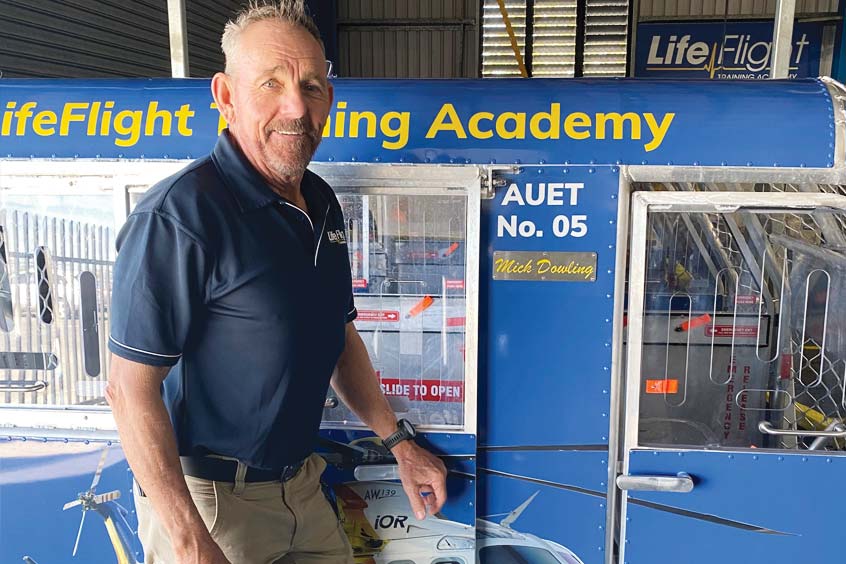
Two new, custom-made aircraft underwater escape simulators at the LifeFlight Training Academy (LTA) in Brisbane International airport are helping equip trainees with the best safety skills to survive in the unlikely event they are trapped in a sinking helicopter.
The third generation dunkers, used in helicopter underwater escape training (HUET), were entirely funded by community donations through the LifeFlight Foundation, which raised $250,000. The donor contributions further ensure helicopter crew members undergo training in the most realistic scenarios and conditions.
"It's been a long haul to get the funding and secure two of these latest generation dunkers for LTA. It's great to have them here. It's a real accomplishment to be able to offer training in generation three machines," says LifeFlight HUET manager Mick Dowling.
The previous generation HUET simulators remain a valuable training tool, but the latest version adds extra challenges and an enhanced training experience. They were designed to meet LifeFlight's operational requirements and replicate more closely the interior features and, most importantly, the exit systems of an AW139 aircraft.
There are two exit systems in the AW139 cockpit, the main doors and emergency exit pull in windows. Both systems have been closely replicated in the third generation HUET dunkers.
"It's relevant to the real world in which many crews are operating. We just had a pilot tell us the new dunker is ideal. He was really impressed," says Dowling. "This is where having a dunker that imitates the real aircraft is so important. It's not just a matter of pushing the window out; they have to find the beading, there's a tab and they have to twist the window. There's a fair bit in it, so to be able to repeatedly run through the process in a safe practice environment is hugely beneficial."
Recently, 25 new LifeFlight critical care doctor recruits underwent their training in one of the AW139 dunkers before they joined aeromedical teams at parent company LifeFlight and other rescue helicopter service bases across Queensland.
"Helicopter underwater escape training is vital for all crew and increases the chances of survival dramatically in the highly unlikely event of a crash," says training academy instructor Shaun Gillott. "The HUET courses offered by LTA are delivered by expert instructors from within the industry, and these new dunkers will only bolster our already exceptional training on offer."
LTA has four dunkers in operation in Australia and now one of them bears Mick Dowling's name, in recognition of the 13 years he has spent at the academy guiding an estimated 10,000 students through the rigours of HUET.
"I didn't know they were going to do that," says Dowling. "It was very unexpected to see my name on there."













 The bimonthly news publication for aviation professionals.
