


 The bimonthly news publication for aviation professionals.
 Read this story in our April 2022 printed issue.
EASA has published the world's first guidance for the design of vertiports, the ground infrastructure needed for the safe operation of urban air mobility services such as air taxis, in locations across Europe, including in urban areas.
The Prototype Technical Design Specifications for Vertiports paper offers guidance to urban planners and local decision-makers as well as industry to enable the safe design of vertiports that will serve these new types of VTOL aircraft, which are already at an advanced stage of development.
“Urban air mobility is a completely new field of aviation, and we therefore have a unique opportunity to develop a set of infrastructure requirements from scratch,” says executive director Patrick Ky. “With the world's first guidance for safe vertiport operations, EASA's ambition is to provide our stakeholders with the 'gold standard' when it comes to safe vertiport design and operational frameworks. By harmonising design and operational standards for vertiports we will support European industry, who are already starting to embark on exciting projects in Europe and around the world to make new urban air mobility a reality.”
Many vertiports will be built within or close to cities, and the guidance offers new and innovative solutions specifically for these congested urban environments.
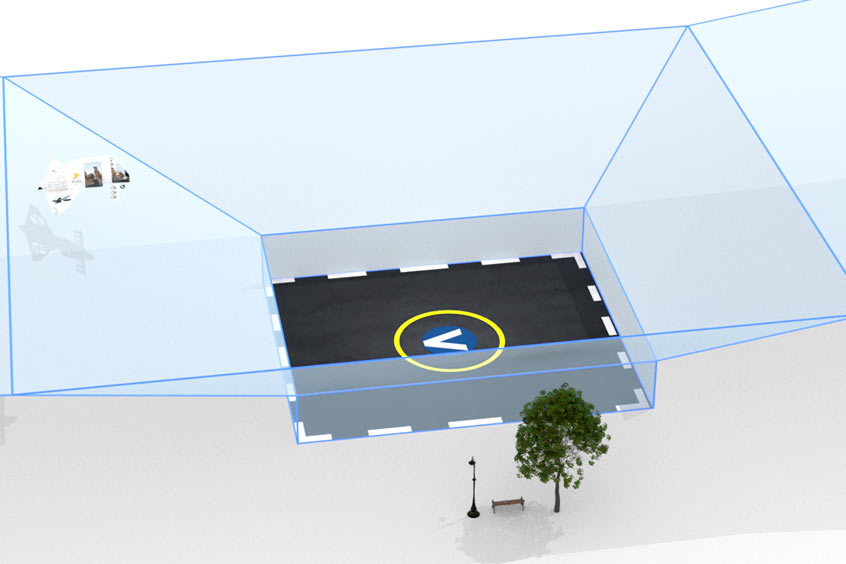
One notable innovation is the concept of a funnel-shaped area above the vertiport, designated as an 'obstacle free volume'. This concept is tailored to the operational capabilities of the new VTOL aircraft, which can perform landing and take off with a significant vertical segment. Depending on the urban environment and on the performance of certain VTOL-capable aircraft, omni-directional trajectories to vertiports will be also possible. Such approaches can more easily take account of environmental and noise restrictions and are more suitable for an urban environment than conventional heliport operations, which are constrained in the approaches that can be safely applied.
This guidance was developed under the leadership of EASA, working in cooperation with the world's leading vertiport companies and VTOL manufacturers, and with the support of experts from European member states. The next step is a full-scale rule-making task (RMT.230) during which EASA will develop the full spectrum of regulatory requirements to ensure safe vertiport operations. These will include not only detailed design specifications, but also requirements for authorities to oversee vertiport operations as well as organisational and operational requirements for vertiport operators.