 The bimonthly news publication for aviation professionals.
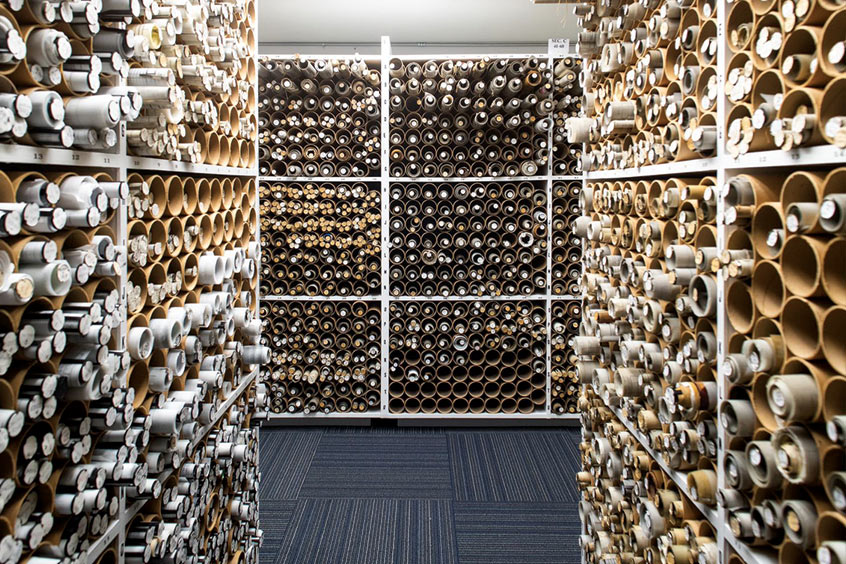
Located down a quiet hallway at Gulfstream's main manufacturing facility, an unmarked door leads to the company's engineering vault. That space, carefully maintained by a team of engineering archivists and data analysts, contains nearly seven decades of Gulfstream's critical engineering documents, thousands of hand-drawn blueprints of parts, cabin designs, aircraft drawings and more, all tightly rolled into tubes and stacked with precision.
“You would never know it was here, but it is probably one of the more important rooms in our entire manufacturing facility,” says senior vice president and chief information officer Sheryl Bunton. “There are hundreds of thousands of documents, including many of the original drawings from the very early days of Grumman and Gulfstream.
“We have incredibly detailed records, but none of them were easily searchable," says Bunton. “We launched a new project to convert all of the records with associated CAD files along with many documents to machine readable PDFs, creating a searchable database called the Aircraft Information Retrieval (AIR) system. This new system will save our engineering, manufacturing and customer support professionals thousands of working hours.”
The US Federal Aviation Administration requires Gulfstream to maintain accurate records of all its aircraft including the type design data from every model dating back to the Gulfstream I that was first manufactured in 1958. Serving as an aircraft time capsule, the room is filled with tube after tube, stacked from floor to ceiling, all holding detailed information on each aircraft.
Bunton says the goal of the project is to not only improve data quality by digitising and preserving the valuable documents, but also to improve usability and consistency: “We are always looking for ways to improve how we manage data and become more efficient. AIR not only digitises hundreds of thousands of records, but ensures we preserve this valuable history of our company and all of the incredibly talented people who spent decades designing and building these amazing aircraft.”
As for the original drawings, Gulfstream plans to keep all of the documents carefully tucked away and stored in its climate-controlled engineering vault.
“These drawings are such a valuable part of our company's history. There is something about pulling out an original hand-drawn blueprint of a Gulfstream I and looking at how designers drafted that iconic aircraft more than 60 years ago," she adds. "They are masterpieces.”