


 The bimonthly news publication for aviation professionals.
 Read this story in our December 2020 printed issue.
One million flight hours, corresponding to more than 114 years non-stop if flown by a single aircraft, have been flown by the global fleet of the P.180 Avanti, since the first unit took off from Genoa airport in the autumn of 1986.
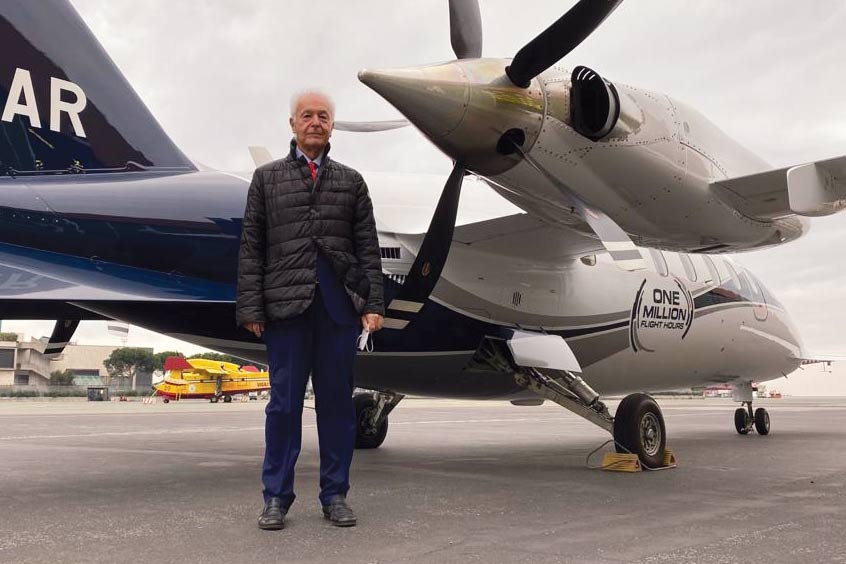
Carrying the flag of this historic event is the prototype registered as I-PJAR, today still active in experimental activities and referred to also as serial number 1002. The aircraft, featuring a new livery expressly designed to celebrate this event, has been recorded in a video while flying over the Ligurian coast, filmed from a piston-powered P.166, recently fully restored.
“Reaching one million flight hours is a milestone that, in the history of the company, carries a symbolic value,” comments Vincenzo Nicastro, the extraordinary commissioner of Piaggio Aerospace. “Exactly two years ago, when I was appointed in December 2018, the company seemed to be close to collapsing. Despite a very negative economic scenario, we have instead succeeded in bringing Piaggio Aerospace back to being fully operational, saving thousands of jobs and a more than 100 year-old brand. We now look forward to soon finding a new owner who, benefiting from a rich order portfolio, will be capable of redesigning the future of the company.”
The Avanti, which in its third variant assumed the name of Avanti EVO, was designed in the early 1980s by a team of engineers led by the aviation designer Alessandro Mazzoni. The target was ambitious: to create a twin turboprop, which is normally slower than a jet, that was faster than a jet of similar dimensions while maintaining lower operating costs.
The result went beyond expectations. The aerodynamic solution with three lifting surfaces contributed to make it the fastest turboprop in the world, but with operating costs 40 per cent lower those of jets of comparable dimensions. At the same time, the pusher propellers and the fuselage design brought to the history of aviation an airplane with an unmatched large, quiet and comfortable cabin. This optimisation of the performances also reflects in the aesthetic of the product.
Piaggio has in total produced 246 P.180s, of which 213 are presently in service in the five continents: 95 are operating in the Americas, 96 in Europe, 18 in the Asia Pacific and four in Africa and the Middle East. The P.180 with the most years of service is known as serial number MSN1004 and is still flying today in the US, while the one with most flight hours is MSN1007, operating in Canada with more than 11,000 flight hours.
Orders for an additional 13 aircraft are at this time under various phases of completion. Among the first to be delivered is the Avanti EVO ordered by a major Asian customer, whose contract has been just recently executed: it is one of the most prominent private operators in the region and will utilise the Avanti EVO for passenger transport, as well as patrolling and air ambulance missions.