 The bimonthly news publication for aviation professionals.
 Read this story in our October 2020 printed issue.
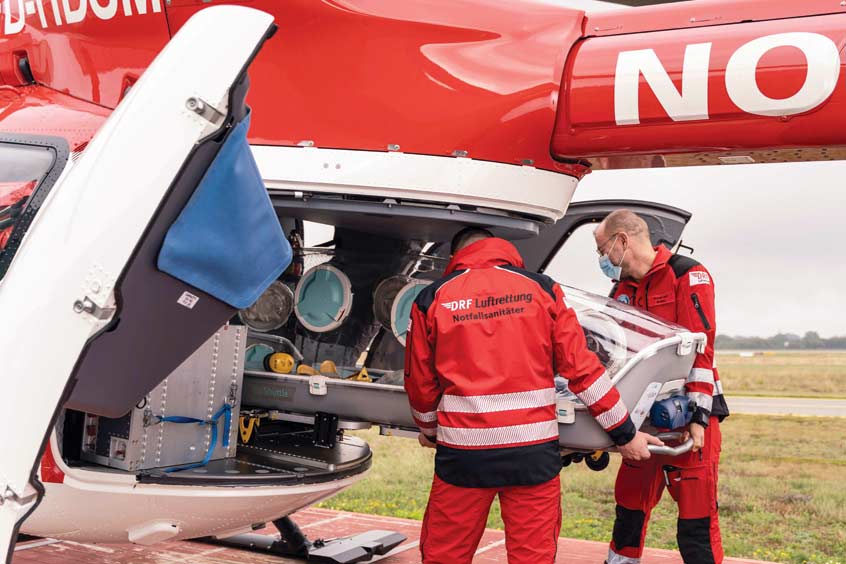
During the COVID-19 pandemic, German air ambulance provider DRF Luftrettung acquired special isolation stretchers to transport highly infectious patients. These stretchers, known as EpiShuttles, can now be fastened in the helicopter thanks to a special ground plate developed by DRF Luftrettung's EASA Part 21 Design Organisation.
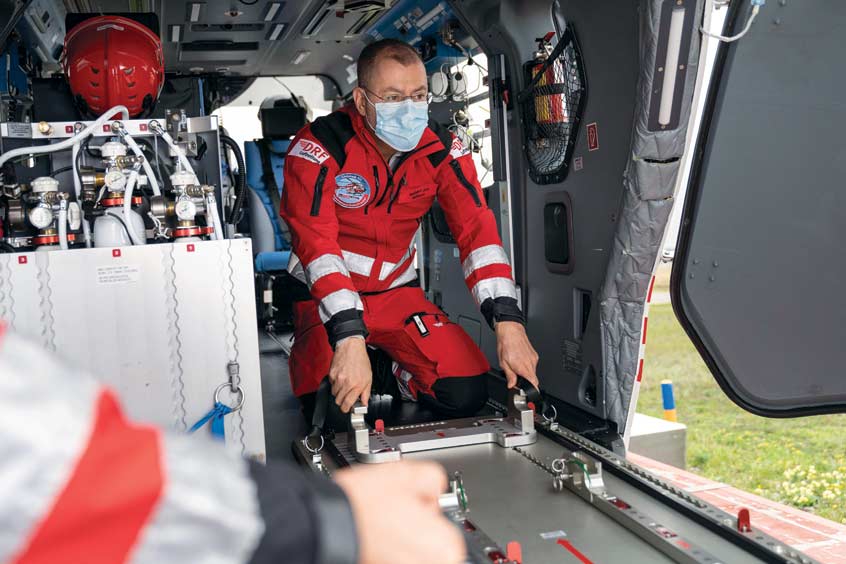
The new solution is both simple and safe. Known as the multifunction EMS ground plate, and with a load-bearing capacity of up to 300 kg, it is currently one-of-a-kind on the market. The corresponding STC was recently issued by EASA, meaning that the product is now ready for series production and can also be made available to external customers.
DRF will use the new plate, which is mounted on the floor of the helicopter, in its ten helicopters that are equipped with EpiShuttles. It has just been installed for the first time in the ‘Christoph 111’ helicopter stationed at Karlsruhe/Baden-Baden airport, which is primarily earmarked for the transport of COVID-19 patients during the pandemic. The other DRF Luftrettung HEMS bases will follow. One advantage is that the helicopter crews can fit the plate themselves in a short time without the need for any tools and can fix the EpiShuttle onto it. This means that they can react quickly and flexibly to the many different situations encountered in air rescue. It will also be possible to use the plate for other transport systems in future, such as incubators.
The German Federal Aviation Office (Luftfahrt-Bundesamt or LBA) had granted a temporary exception regulation for an alternative EpiShuttle mounting that has been used to date. As such, a new solution had to be developed that not only meets the requirements of the helicopter models used, but also allows faster and improved handling by the teams. The Part 21 Design Organisation at DRF Luftrettung has been working at full speed over recent months to develop a prototype of the new plate. To ensure that the product meets the building specifications for the helicopter and legal regulations, the team conducted extensive functional tests and ultimately obtained the relevant approvals. The STC from EASA enables DRF Luftrettung to install the plate in its own fleet of BK 117 C2 and BK 117 D2 helicopters. In addition, a Form 1 from the Federal Aviation Office confirms the plate’s basic suitability for aeronautical vehicles, paving the way for its sale to external customers.
Providing patients with optimal emergency medical care and transporting them quickly and safely to the right hospital by air is the primary task of DRF Luftrettung. “We stand for advancement in emergency medical care,” states COO Peter Huber. “The new product from DRF Luftrettung is the best way of showing that we are able to develop innovative solutions that benefit patient safety in-house within a short time. We are proud of the fact that other aviation companies can also benefit from the expertise of our Design Organisation.”