


 The bimonthly news publication for aviation professionals.
 Read this story in our August 2019 printed issue.
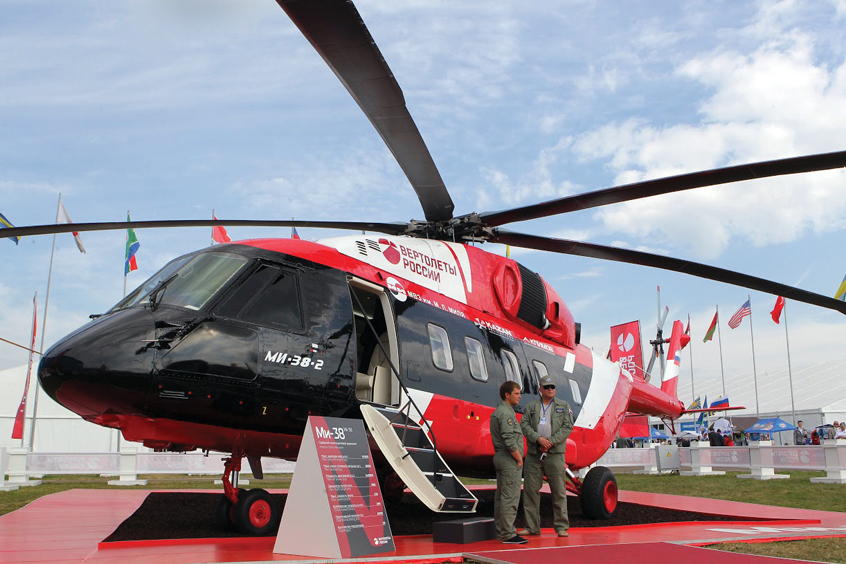
Specialists at the Mil Moscow Helicopter Plant, a subsidiary of the Russian Helicopters holding, itself a part of Rostec, have completed a series of Mi-38 flights conducted under instrument flight rules (IFR), as well as in extremely high temperature and high altitude conditions. Test results have been delivered to Russia's Federal Air Transport Agency Rosaviatsiya to make additions to the helicopter type certificate.
In particular, the helicopter made more than 50 flights in the city of Astrakhan, confirming its ability to operate at ambient temperatures of up to 45 degrees celsius. High altitude tests were conducted at Mount Elbrus in Russia's Caucasus mountains and results confirmed the Mi-38's ability to fly in altitudes of up to 3,000m above sea level. In addition, the helicopter made a series of 50 flights to evaluate piloting and navigation in the absence of visual visibility of landmarks and the horizon.
“Considering the high interest in the helicopter from both Russian and foreign customers, we're trying to test and document the Mi-38's capabilities to the maximum,” says says Russian Helicopters director general Andrey Boginsky. “In particular, we are planning to test a new surveillance system and certify new hardened main rotor blades, which will also be used in Mi-171A2, in the near future.”
The Mi-38 is equipped with new Russian-made high-performance TV7-117V engines, an integrated digital flight-navigation system with data display on five LCD displays and a protected explosion-proof fuel system. The helicopter also comes with additional supports for the landing gear for soft ground and snow landings. Mi-38's IBKO-38 integrated set of onboard equipment provides the crew with high definition information necessary for ensuring a high level of flight safety. The helicopter cabin has seats which are easy to remove, removable sanitary facilities and rollers to transport cargo.
The Mi-38 helicopter can be used for transporting cargo and passengers, search and rescue operations and VIP transportation. These operations can be conducted in a wide range of climates, including maritime, tropical and cold environments.