See more information from the Business Air News Handbook
Press Release
Issued by Daher Aerospace.
December 10, 2024
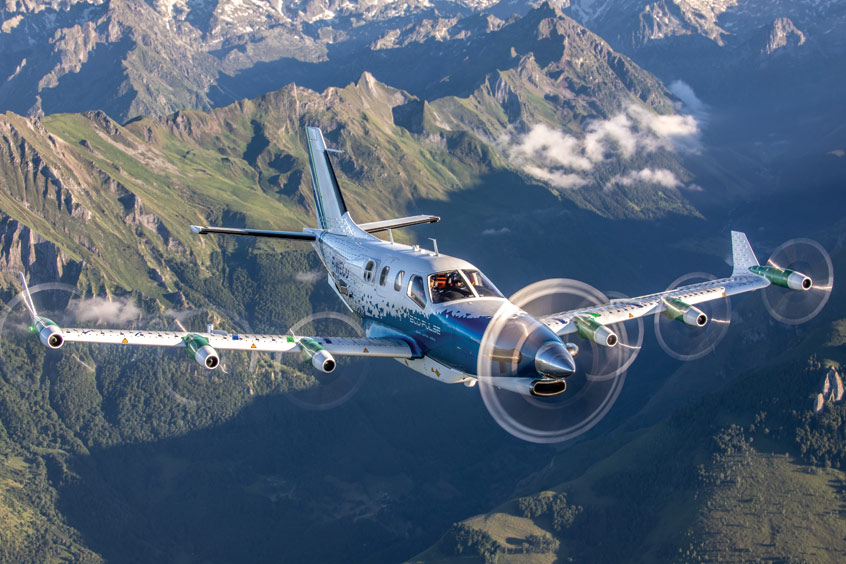
EcoPulse, the distributed hybrid-electric propulsion aircraft demonstrator developed jointly by Daher, Safran and Airbus, has concluded its flight test campaign, delivering crucial insights to meet the decarbonisation goals for air transport by 2050. This collaborative project, which is emblematic of the French aerospace sector, has provided unique experience in the design, certification, production and operation of hybrid-electric aircraft.
EcoPulse is a collaborative project supported by CORAC (the French Civil Aeronautics Research Council) and co-financed by the DGAC (French Civil Aviation Authority) through France Relance and NextGeneration EU.
Unveiled at the 2019 Paris Air Show, EcoPulse is based on a Daher TBM aircraft platform and equipped with six e-propellers provided by Safran and distributed along its wings. Its propulsion system integrates two energy sources: a turbogenerator, an electric generator driven by a gas turbine provided by Safran, and a high-voltage battery pack provided by Airbus. At the heart of this architecture lies a Power Distribution and Rectification Unit (PDRU), which protects the high-voltage network and distributes available electrical power, along with high-voltage supply harnesses both provided by Safran. The battery, designed by Airbus, is rated for 800 volts DC and can deliver up to 350 kilowatts of power.
The demonstrator also benefits from the aerodynamic and acoustic integration expertise of the European aircraft manufacturer, with Airbus' development of the flight control computer enabling aircraft manoeuvres via the e-propellers and synchro-phasing to support future acoustic recommendations for aircraft.
EcoPulse performed its first hybrid-electric test flight on November 29, 2023, from Tarbes Lourdes Pyrénées Airport. Since its maiden flight, EcoPulse has accumulated 100 flight hours and performed some 50 test flights with the distributed hybrid propulsion system, the last of which took place in July 2024. These tests enabled the demonstration of unprecedented onboard electric power levels for distributed electric propulsion, with a network voltage of approximately 800 volts DC and a power output of 350 kilowatts.
The flight tests yielded significant findings, including an objective evaluation of hybridisation technologies' maturity, a performance assessment when integrated into the aircraft and an identification of operational limitations.
For instance, the tests showed that the synchro-phasing of the e-propellers (electric motors) can reduce interior noise. This synchro-phasing is an additional benefit of the innovative flight control computer, primarily designed to manoeuvre the aircraft, substituting traditional control surfaces, by adjusting the distribution of electric power among the e-propellers.
More broadly, EcoPulse identified key challenges in decarbonising aviation:
- Electric and hybrid-electric architectures;
- Development of key components: batteries (performance and operational range) and high-voltage management systems (>400 V);
- Pilot assistance with specialised interfaces;
- Demonstration logic for airworthiness;
- Optimisation of weight and noise; and
- Skills associated with managing complexity.
The flight test campaign laid the groundwork for compliance documents to meet the regulatory requirements for hybrid-electric propulsion flights, establishing the basis for certifying the safety of innovative aircraft configurations.
The EcoPulse project showcases the strength of high-level cooperation between Daher, Safran and Airbus. By pooling their expertise and test resources, the partners demonstrated significant synergies between general aviation and commercial aviation.
"We are particularly pleased with the success of the EcoPulse programme and its results. This was the first time we tested a complete hybrid-electric propulsion system in flight, and these trials represented a significant milestone in our technology roadmap," said Eric Dalbiès, senior vice president, strategy and chief technology officer at Safran. "The lessons learned enable us to continue validating decarbonisation technologies."
“EcoPulse has enabled Daher to take a crucial step forward in developing a low-carbon aircraft. This project not only helped us design an operational system for a demonstration prototype but also tackle critical technological hurdles. Thanks to this rich and unprecedented collaboration, we have made significant progress toward hybridisation,” emphasised Pascal Laguerre, chief technology officer of Daher.
“This EcoPulse campaign allows us to advance certain hybrid-electric technologies, such as high-voltage batteries, and integrate them into future aircraft, helicopters and air mobility solutions,” said Jean-Baptiste Manchette, head of propulsion of Tomorrow at Airbus. “With distributed electric propulsion, we achieved our goal of modelling flight physics and energy management at the aircraft level, key elements for shaping the next generation of aircraft,” he added.
With the conclusion of the EcoPulse programme, Daher, Safran and Airbus reaffirm their commitment to sustainable aviation. This pioneering project lays the groundwork for the technological and regulatory advancements needed to address the environmental challenges of future air transport.