 The bimonthly news publication for aviation professionals.
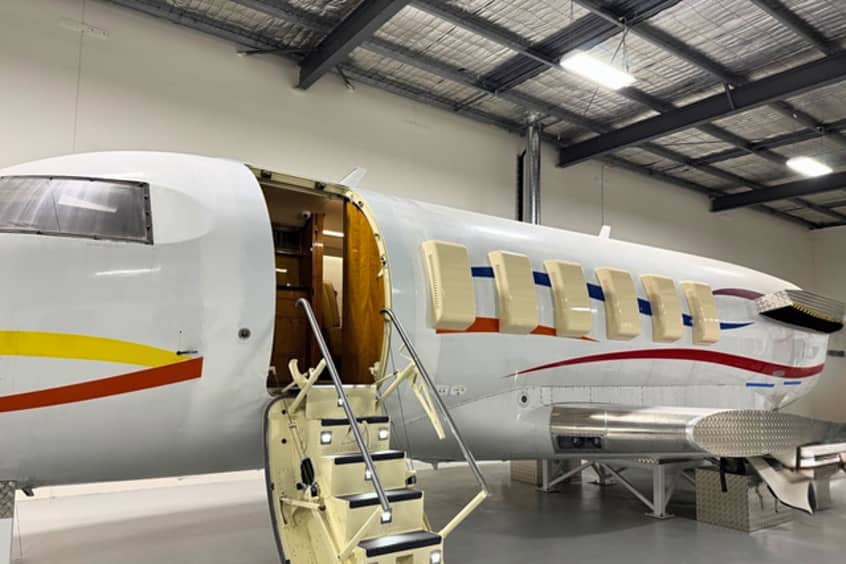
CrewSafety has transformed a Challenger 605 into a Cabin Emergency Evacuation Trainer (CEET) and is now taking bookings for training at its Melbourne facility. UAE-based Spatial Composite Solutions delivered the specialist engineering and systems integration, specifically a new training door, replacement electrical systems and visual systems, combining specialist component manufacturing in the UAE with hands-on installation and upgrade work in Melbourne.
The project gives business aviation crews and personnel working in intelligence, surveillance and reconnaissance, law enforcement, rescue and aeromedical operations the opportunity to practise realistic, scenario-based emergency procedures inside a genuine business jet cabin.
“For us,” says Joseph Marks, CEO of CrewSafety Australia, “the opportunity is to support the people carrying out those missions with practical emergency training. In an aeromedical operation, that could include pilots, medical staff and other personnel who need to work together during an aircraft emergency.
“Crews need to make decisions and act quickly in the environment they know. That is why we wanted to start with a real aircraft. Spatial helped us turn an exceptionally well-preserved Challenger into a training device that will let crews practise in an authentic cabin and build confidence for the moments that matter most.”
CrewSafety’s website states that the CEET is the only one of its kind in the Southern Hemisphere, giving crews unmatched realism in emergency evacuation training. It meets and exceeds all applicable ICAO, FAA, EASA and Transport Canada standards for cabin training devices, and the company will work with Australian and international operators to support their training requirements. Overseas customers should confirm with their national aviation authority how training on the CEET can be incorporated into their own regulatory arrangements.
The aircraft's original structure and much of its interior have been retained, including the cabin, galley and flight deck.
Converting an existing jet presents a different challenge from building a simulator from scratch. Every new training system must be integrated around the aircraft’s original structure and interior, while preserving the features that make the experience realistic.
Marc Van den Broucque, owner and managing director at Spatial Composite Solutions, says: “This is a particularly interesting project as it is exceedingly rare to be offered an airframe in such good and complete condition. The challenge has been integrating the functionality CrewSafety needs while retaining the authenticity of the original business jet wherever possible. It’s exactly the kind of bespoke engineering challenge our team enjoys taking on.”
There has been interest from a broad range of Australian operators. “The attraction is straightforward,” says Marks. “Crews can practise emergency procedures in a real business jet cabin. That gives operators a compelling opportunity to make practical training more relevant to the environment their people work in.”
The CEET is an exciting step in CrewSafety’s longer-term plans for Melbourne. The company is already in commercial discussions with industry operators about additional training equipment that would complement existing facilities; its focus is on investment that responds to operator needs and gives crews access to more of their practical emergency training in one location.
“Our Bombardier business jet-based CEET provides a platform for discussing those needs with operators and developing suitable training, subject to their aircraft configuration and regulatory requirements,” says Marks. “Commercially, this broadens our potential customer base while keeping us focused on what CrewSafety does best: helping people prepare for emergencies before they happen.”