


 The bimonthly news publication for aviation professionals.
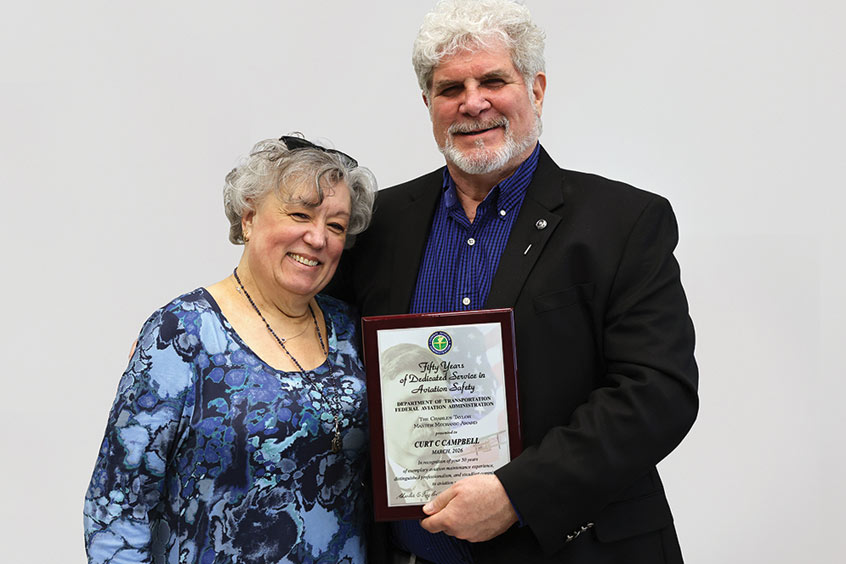
During a reception on 11 March at Duncan Aviation in Lincoln, Nebraska, Curt Campbell, who recently retired as an avionics component tech rep and is a familiar name to just about anyone who's ever had an autopilot question, was honoured as a recipient of the prestigious Charles Taylor Master Mechanic Award.
Named after Charles Taylor, the mechanic behind the Wright brothers' first successful aircraft engine, this award represents the gold standard in aviation maintenance. It recognises more than longevity; it reflects a lifetime of skill, integrity and showing up day after day for over 50 years without a single certification revocation. Simply put, it's not just earned. It's lived.
Campbell, with his wife Martha by his side, was presented the award by the FAA FAASTeam programme manager, Mark Gaffney, at the reception at Duncan Aviation. It was attended by company leadership, colleagues and a small group of invited guests. Although he is the ninth Duncan Aviation employee to receive the award, Campbell also holds the distinction of being the first avionics repairman from Duncan Aviation to receive this honour.
For over 50 years, Campbell didn't just work in aviation; he helped shape it. Known throughout the industry as the go-to for autopilot expertise, he built a reputation not only for what he knew, but also for how he showed up: listening first, solving second and never walking away from a problem until it was fully understood and fully resolved. Campbell's remarkable five-decade journey with Duncan Aviation is a legacy defined by technical excellence, unwavering dedication and an enduring commitment to outstanding customer service.
His career with Duncan Aviation began on May 19, 1975, as an avionics instrument technician specialising in flight control and Learjet ancillary systems. His early years were marked by his hands-on expertise and countless hours aboard test flights, where he honed a deep understanding of aircraft avionics and flight characteristics from both a technician's and a flight crew's perspectives. He gained a rare perspective that would define his approach for years to come, seeing not just how systems work, but how they perform where it matters most: in the air.
From lead technician for his first 10 years, to more than 40 years as an avionics technical representative, Campbell became a steady presence and a trusted voice within Duncan Aviation's avionics instrument department. He trained and mentored generations of technicians and managers, designed and delivered industry-renowned training at AEA conventions and contributed significantly to engineering innovations, including troubleshooting software, adapter designs and test equipment.
“Curt was known as the go-to guy for autopilot expertise in the industry,” says Mark Cote, vice president of parts and rotables sales and component services. “He had a way of listening, simplifying the complex and staying with a problem until it was solved.”
Duncan Aviation chairman Todd Duncan expresses his appreciation for the wisdom Campbell imparted during his tenure at Duncan Aviation. “We grew and flourished because of people like Curt and those who came before and after him.”
For Campbell, the recognition is meaningful: “It seems like yesterday that I began my career. I didn't get here on my own. I stood on the shoulders of many great people who are no longer here. I learned from them and listened, passing along the knowledge I gained to others. I'm proud of the people and the company I leave behind.”