


 The bimonthly news publication for aviation professionals.
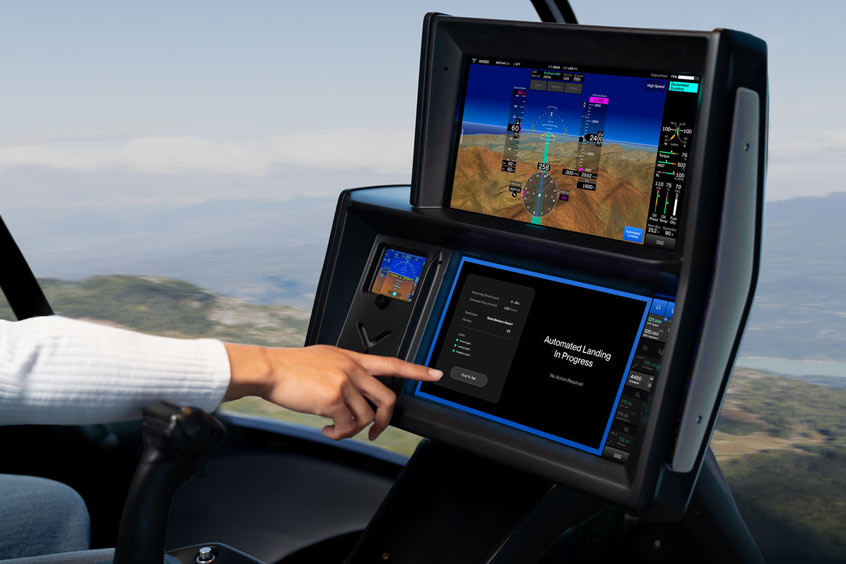
Skyryse is developing an emergency autoland capability for helicopters and aeroplanes through its SkyOS flight operating system. The system allows an aircraft to execute a safe emergency landing sequence through a single command. SkyOS relies on a triply redundant fly-by-wire architecture incorporating a human-machine interface, advanced sensor fusion and software-defined flight control laws.
During an emergency, the system maintains a stable aircraft profile, navigates toward a suitable landing site, manages aircraft energy and completes approach and touchdown.
When activated by a pilot or passenger, SkyOS monitors altitude, speed, trajectory and envelope limits while managing power and performing a controlled landing suited to the surrounding environment.
The feature builds on other SkyOS automation capabilities including inherent stability, simplified flight controls, dynamic envelope protection, terrain awareness, obstacle detection, fuel monitoring and weather assessment.
Autoland capability represents a significant development for helicopters where automated landing systems have historically proven difficult to deploy because of confined landing areas, low-altitude operations and complex energy management.
Skyryse has previously demonstrated automated engine-out landing, also known as autorotation, one of the most demanding emergency scenarios in rotorcraft operations.
“By creating a holistic software-hardware solution like SkyOS, we're able to develop and integrate lifesaving features like emergency autoland at unprecedented speed,” says Mark Groden, founder and CEO at Skyryse.
Skyryse expects the capability to support emergency scenarios such as pilot incapacitation, spatial disorientation, severe weather encounters and other high-workload situations.
Certification work will follow approval of Skyryse One, the Robinson R66 helicopter modified with the SkyOS operating system.