• Air Bravo Corporation
Charter
• Air du Cap
Charter
• Helimo
Charter
• JetAdore
• University Air Center
Charter
BAN's World Gazetteer
• Canada The bimonthly news publication for aviation professionals.


Air charter brokers are the matchmakers of business aviation: they know who has an aircraft, who needs one and how to get the two together. They don’t replace operator sales efforts; they amplify them.
But they can occupy an awkward middle ground. To some, brokers are an unnecessary middle layer with a commission attached; to others, a useful filter. But when trips get complex, timelines shorten and expectations stretch, brokers are often the first port of call.
Business Air News explores what charter brokers bring to the party. They may influence fleet utilisation and revenue growth, but they also bring commission fees, less direct interaction with clients and a dependence on third parties for revenue. Apart from finding an appropriate operator by assessing client needs, taking on the administrative burden by handling the logistics of scheduling, pricing and contracts, and providing client support before, during and after a flight, what have charter brokers ever done for us?
There are shifts in the charter space in South Africa, according to Air du Cap, and one of the most noticeable trends has been an increase in direct bookings. “Brokers still play a key role, especially for multi-leg trips and concierge-style services, but customers are clearly looking for faster quoting and more transparent pricing,” says founder and CEO Will Mellor. “People want to search, get a real price and confirm a flight, without having to wait.”
To meet that expectation, the company has been working closely with the JetAdore broker team, whose platform now powers all its pricing and bookings. This partnership has introduced a level of precision that wasn’t possible with manual quoting. Instead of offering broad averages, the system looks at the real position of every aircraft and calculates the most efficient routing.
When someone searches for a flight, the platform compares the cost of returning an aircraft to base versus keeping it at the endpoint. It factors in pilot duty limits, accommodation, waiting time and associated crew costs, and weighs that against the cost of flying the aircraft back home. If holding the aircraft saves money, the customer automatically sees a price that reflects that saving.
The same applies when there is another confirmed charter shortly after the requested trip. JetAdore compares the cost of sending the aircraft back to base with the cost of positioning it straight to the next departure point. If skipping base produces a better outcome, that benefit is passed directly to the customer.
“It has removed unnecessary legs and made pricing more honest and efficient,” says Mellor. “A big win for us has been the way the system supports brokers rather than competes with them.”
Brokers can have their own logins, view live pricing and send branded quotes directly to their clients with their commission already built in. It has kept them fully in the loop while simplifying their workflow. Instead of waiting for operators to price a trip, they can move as quickly as direct customers now do. It’s a smoother, more transparent way to serve clients.
For travellers, the result is instant pricing, online payment and tickets issued immediately, and for operators, it is fewer dead legs and smarter scheduling.
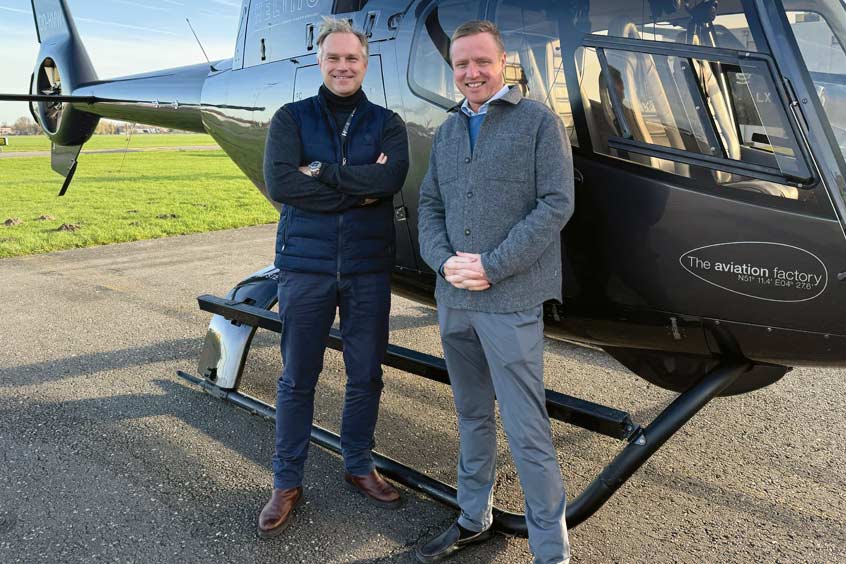
In the increasingly competitive landscape of European business aviation, collaboration has become a key driver of sustainable growth, customer satisfaction and operational efficiency. Recognising the value of strategic alliances, Belgium-based Helimo entered into a partnership with The Aviation Factory, a private jet and charter broker headquartered at Antwerp airport. The goal was to leverage Helimo’s operational expertise and fleet capabilities with The Aviation Factory’s commercial reach, marketing capacity and international client network. The result, according to Helimo owner Michael Wilford, is a more streamlined offering to the market, improved access to rotor-wing solutions and enhanced flexibility for customers seeking point-to-point mobility across Belgium and surrounding regions.
The Aviation Factory has developed a strong reputation over the past decade as a trusted broker in the fixed-wing charter sector, known for its reliability, customer-centric approach and extensive network in corporate and VIP aviation. Its team has experience managing complex itineraries and sourcing tailored aircraft solutions for demanding clients.
“By connecting its brokerage know-how with our operational capability, both companies bring increased value to the market,” explains Wilford. “For clients, the cooperation is particularly impactful. Business aviation passengers increasingly expect multimodal mobility rather than single-aircraft solutions. The partnership allows charter customers to book a private jet and onward helicopter transfer through a single point of contact while benefiting from unified communication, simplified operations and coordinated dispatching.”
In an industry where time and efficiency are key value drivers, this creates a clear competitive advantage. Since the launch, Helimo has observed measurable improvements in customer satisfaction as well as a notable rise in flight activity.
Looking ahead, the partners plan to expand the helicopter offering in Belgium and beyond, developing integrated jet-to-heli travel packages while responding to future mobility trends including the emergence of AAM and eVTOL aircraft.
“This partnership demonstrates that collaboration, not competition, drives progress in aviation,” Wilford concludes.
On the other hand, Air Bravo, celebrating its 25th anniversary in January 2026, finds bookings mostly come direct from customers rather than through brokers, primarily due to cost. Using a broker typically adds 10–20 per cent to the price compared to booking directly with the service provider. President Rick Horwath started the company from a small base with the goal of providing much-needed flight services to Canada’s Northwest Territories. He says: “Very little of Air Bravo’s growth over the years has been influenced by charter brokers.”
Today, Air Bravo is the largest PC-12 operator in Canada and is currently in the process of opening an AOC in the US. Its operations are predominantly split between medevac and charter services.
Horwath explains that brokers operate almost exclusively out of major cities such as Toronto, Montreal and Vancouver, and generally have limited knowledge of northern operations. Their client base tends to be the corporate sector, passengers who prefer warm destinations, major airports and the traditional business aviation experience complete with comfort, amenities and onboard service. This corporate market is valuable, but it is also a niche segment and not always sustainable. Even slight economic changes can dramatically reduce corporate travel demand.
Many brokers work on a commission basis, meaning higher quotes result in higher earnings for them. Once the transaction is complete, the relationship between the broker and customer generally ends.
“When customers book directly with us, they receive firsthand service, transparent pricing and the opportunity to build a reliable, long-term relationship with our team,” says Horwath. “Aviation is a small industry where reputation, relationships and reliable service matter. Success often comes down to who can provide the best customer experience at a fair price while maintaining operational viability.”
For Air Bravo, only one broker, Air Charter Services, regularly uses its services, typically when it represents mining companies that choose to contact them directly.
Similarly, Florida-based University Air Center (UAC) has operated as an FAA Part 135 carrier since 1983. The organisation is built on a culture of safety and professionalism, supported by a team with remarkably low turnover.
“We have grown primarily through direct relationships with local partners rather than through broad commercial marketing,” says CEO and director of flight operations Dr Michael Lukowski. “Our business model emphasises long-term partnerships over transactional services.”
The majority of its operations support medical teams involved in organ procurement and the transport of critically ill patients to tertiary care facilities. The medical teams require safe, reliable and immediate transport 24 hours a day, 365 days a year, and meeting these expectations requires rigorous pilot training, meticulous aircraft maintenance and precise, rapid coordination among multiple stakeholders during each mission. UAC provides staff with the tools, systems and communication resources necessary to perform with accuracy and consistency, ensuring efficient and dependable service.
“While we occasionally work with brokers for medical and business charter flights, the experience level and operational understanding among brokerage firms vary significantly,” adds Lukowski. He does maintain a strong relationship with one broker whose aviation and medical transport background aligns closely with UAC’s own standards, but finds that many smaller brokers prioritise pricing over operational competence, and some larger brokers, despite their scale, rely on call centres and generalised processes that make it difficult for them to effectively support the complexities of medical transport missions.