



• NBAA Business Aviation Convention & Exhibition 2026
BAN's World Gazetteer
• Florida The bimonthly news publication for aviation professionals.



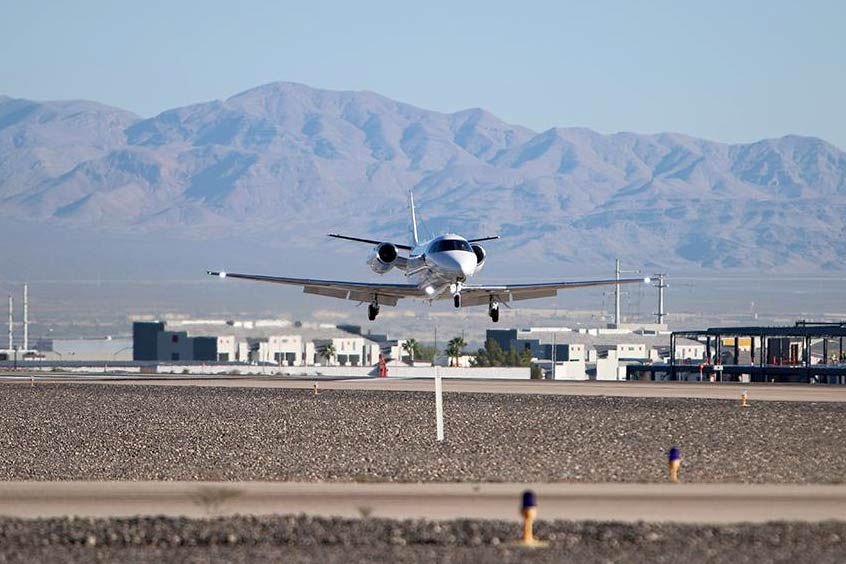


One might say the mood at this year’s NBAA-BACE show leaned toward guarded optimism, and certainly a panel of aircraft brokers were leaning that way during a Flight Deck session. While there may be macroeconomic challenges, regulatory complexities and workforce constraints, many believe the sector is holding up well. Global Jet Capital (GJC) projects continued growth for the next five years, keeping pace with resilient economic growth and wealth creation worldwide.
Overall the show reflected an industry in transition, still energised from the post‑pandemic surge but also adjusting towards more sustainable, disciplined growth.
Aircraft and product unveilings were a major draw. Textron debuted its Citation Ascend ahead of its certification later in the year. The launch customer is NetJets within a multi-year 1,500-aircraft contract for the Citation Longitude, Latitude and the Ascend.
Gulfstream showcased its G400, G600, G700 and G800, and the new G300 mock-up made its first appearance. Bombardier displayed its Global 7500, Global 6500 and Challenger 3500, and announced a new top speed for its ultra long-range Global 8000 of Mach 0.95 along with delivery of the type to Comlux next year.
Otto Aerospace unveiled its laminar-flow, ‘windowless’ concept Phantom 3500, while Archer Aviation brought its Midnight eVTOL and startups like Boom Supersonic exhibited. Boom is a Colorado-based startup developing its boom-less Overture supersonic airliner, with FAA type certification targeted by 2030.
New aircraft demand remains relatively strong. JetNet reported 455 new jets delivered in the first half of this year, with a full-year forecast of around 820. Honeywell’s pre-show forecast estimated 8,500 jet deliveries over the next decade at a value of about $283 billion, underpinned by sustained user interest and operator confidence. Brokers at the show reported that sales of both new and pre‑owned business aircraft remain strong, despite the pressures of tariffs and limited inspection slots.
GJC believes OEMs should steadily increase deliveries to fulfil high backlogs as lead times remain long, which has led to increased activity in the pre-owned market from buyers with immediate needs. The company projects $206 billion in total transaction volume of new and pre-owned aircraft between 2025 and 2029, with dollar volume expected to grow at an average annualised rate of 3.9 per cent during that time. It also forecasts that deliveries of all size categories will increase during the period, but heavy long-range jet demand should increase at faster rates as demand favours more range and capacity. North America is expected to remain the largest business jet market over the next five years, while Latin America is poised to overtake Europe as the second largest market by virtue of its high demand for pre-owned jets.
Some speakers cautioned that deals are being rushed to close by year-end to capture favourable tax timing, i.e., bonus depreciation. Thus demand seems resilient, solid perhaps, as long as interest rates, economic downturns or regulatory shifts do not disrupt sentiment. Constrained capacity in inspections, close‑out delays and parts lead times are potential bottlenecks.
Several themes seem to define the near‑term landscape.
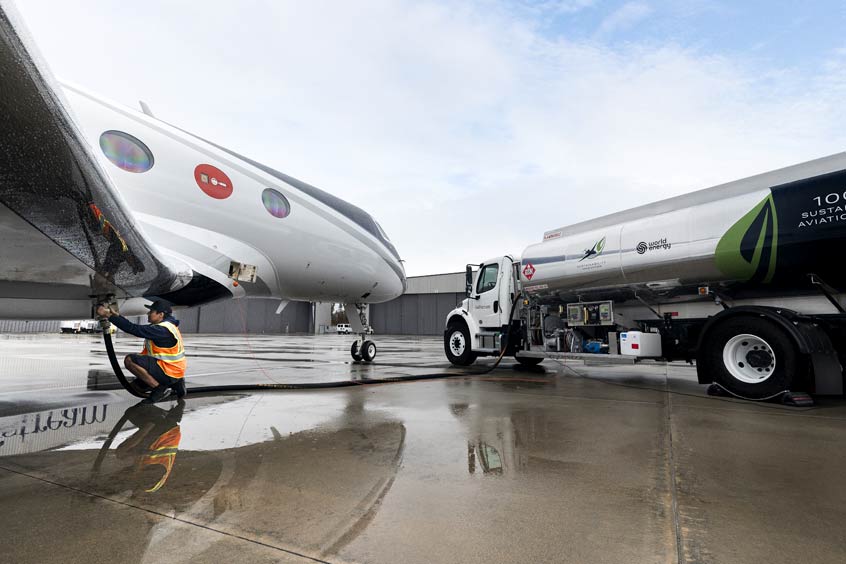
Sustainability is evolving from a topic of aspiration to one of execution. Producers and operators are focused on how to source, verify and integrate SAF. Sustainable fuel was physically available at Henderson Executive and North Las Vegas airports throughout the show, and book‑and‑claim schemes allowed participants to log emissions credits without physical uplift. The Sustainability Summit addressed scaling SAF, hybrid/hydrogen propulsion and FBO/infrastructure readiness. While interest is high, SAF volumes remain constrained due to scaling feedstock, production, certification and fuel logistics. Cost differentials between conventional jet fuel and SAF are still material, meaning adoption may be uneven, and fuelling, storage and delivery at FBOs and regional airports will need substantial investment to support broader uptake.
AI adoption is migrating from back‑office support to embedded systems within the aircraft and operations chain. Predictive diagnostics, digital cockpits, augmented reality for training and better connected ops software were on view in the MRO and avionics halls, and OEMs and operators will be investing in AI tools for better parts forecasting, improved service response and reduced downtime. JetNet unveiled its AI-powered intelligence platform, which enables natural-language queries across aviation market data.
OEMs and service providers reported a shortage of skilled technicians, engineers and pilots. The challenge is more than just finding people, apparently; it’s also training and upskilling lower-skilled entrants into higher technical roles.
ATC modernisation remains critical; there’s regulatory pressure on integrating drones and urban air mobility into the national airspace. And tariff pressures, especially between the US and export markets, are creating bifurcation. US-registered jets are more easily traded domestically than overseas. Political uncertainty over tax rules and trade agreements may be causing buyers and sellers to accelerate deal timings.
Business aviation’s finance and leasing markets are growth drivers. Interest rates, asset valuations and equity markets will heavily influence purchase decisions, but product innovations in financing may help lower barriers to entry. Fractional and charter operators may drive a significant share of growth, especially in midsize/super midsize classes: Bond, a fractional ownership company, launched at the show with firm orders for 50 Challenger 3500s and Global 6500s.
While optimism is evident, risks exist from rising interest rates, inflation or a recession. Sudden changes in emissions regulations, tax incentives, import/export rules or airspace policy could create disruption. Delays in parts, material costs and certification bottlenecks might slow OEM deliveries and spare parts support. Operators may find themselves stuck between regulatory pressure and limited options if there are delays to SAF availability or the certification of new propulsion technologies or infrastructure. And if the industry cannot scale its workforce fast enough, growth may be constrained irrespective of demand.
Day one was dubbed ‘Inspiration From Dawn to Dusk’, and ended with a sunset toast to aviation, which sounds rather more like a swan song than was probably intended. Overall, NBAA‑BACE 2025 stood out for pushing real progress in sustainability and safety; a shift toward practical deployment rather than just aspirational goals, and positioning business aviation towards a more immersive, digitally enabled future.