The bimonthly news publication for aviation professionals.
 Read this story in our July/August 2025 printed issue.
The Los Angeles Board of Airport Commissioners (BOAC) today approved two initiatives aimed at reducing emissions from ground service equipment (GSE) at Van Nuys Airport (VNY) to zero by 2030. This marks the first time a general aviation airport in the United States has introduced such measures.
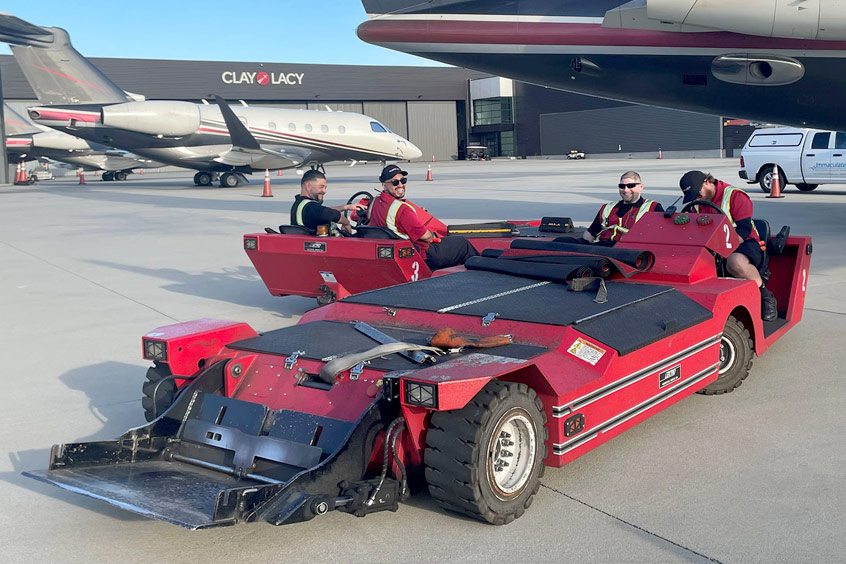
The Zero-Emission GSE Policy (ZE Policy) mandates replacing all GSE vehicles at VNY with zero-emission models by January 2030, provided suitable commercial alternatives exist. Complementing this, the Zero-Emission GSE Incentive Program will offer $250,000 in reimbursement grants to encourage operators to adopt zero-emission equipment. Incentives range from $10,000 to $65,000 depending on the equipment type, prioritising replacement of the highest-emitting vehicles. Older GSE models must be scrapped or moved out of California.
“These initiatives ensure Van Nuys Airport remains a responsible operator and neighbour, solidifying our sustainability commitments,” says Karim Webb, president, BOAC. “Sustainability influences every aspect of how Los Angeles World Airports operates, and this policy and incentive programme demonstrate our determination to achieve cleaner air.”
Officials estimate a reduction of more than 2.29 tons of nitrogen oxide (NOx) emissions and 465 metric tons of carbon dioxide equivalent (CO₂e) emissions by 2030. VNY currently hosts over 200 motorised GSE vehicles, including aircraft tractors, cargo tractors, and ground power units, and expects up to 20 to be replaced initially.
In addition, VNY and Los Angeles International Airport (LAX) achieved Level 4 – Transformation accreditation from Airports Council International Europe’s Airport Carbon Accreditation (ACA). This accreditation recognises LAWA's progress toward its sustainability goal of carbon neutrality from airport operations by 2045. VNY is now the first general aviation airport in the Americas certified at this level, recognising both airport authority and third-party emissions management.
“Ground support equipment is a significant emissions source at any airport,” says Jacob Haik, Van Nuys airport manager, Los Angeles World Airports (LAWA). “Our policies today accelerate Van Nuys’ leadership role in achieving carbon neutrality.”
Los Angeles Mayor Karen Bass praised the achievements, highlighting LAWA’s ongoing leadership in sustainability. John Ackerman, CEO of LAWA, also recognised the airports' accomplishments: “Our airports continue to invest in sustainability, safety, and improved experiences.”
LAX has similarly advanced sustainability, with milestones including a 26% reduction in energy per passenger since 2011 and significant expansions of electric vehicle infrastructure. VNY itself saw notable emissions reductions, energy consumption decreases, and increased sustainable fuel use between 2023 and 2024.