 The bimonthly news publication for aviation professionals.
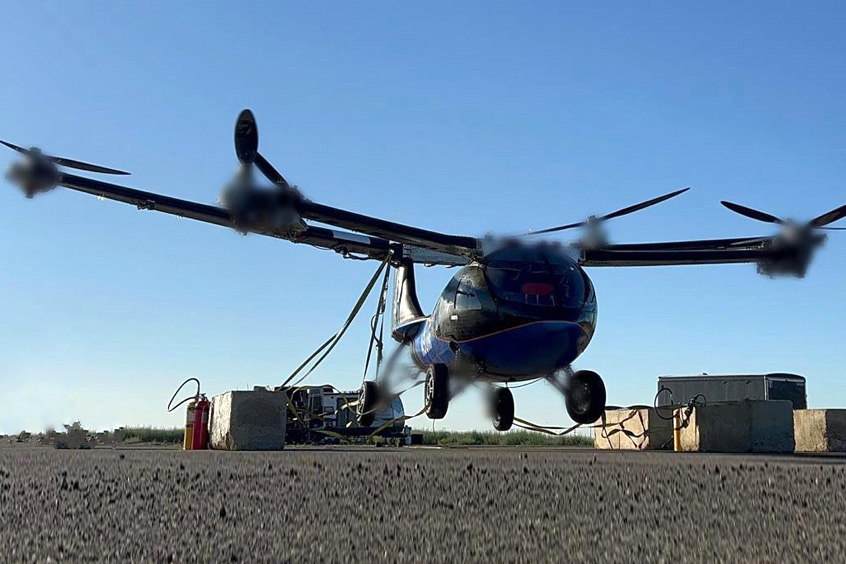
A full-scale prototype of Silicon Valley air mobility company Aska's A5 flying car has successfully completed its first airborne tests, lifting from a California airfield with hovered thrust while the vehicle was tethered to the ground.
The size of an SUV in the drive mode, the four-seater Aska A5 can travel by road and air with VTOL and STOL capabilities. The drive and fly eVTOL is designed with maximum safety standards and a 250 mile flight range. On 30 June, the company reported that the A5 had achieved Certificate of Authorisation (COA) and Special Airworthiness Certification by the FAA. The Aska A5 is also the world's first flying car to start the type certification process with the FAA.
The Aska A5 has also received authorisation to drive on public roads from the Department of Motor Vehicles (DMV) and the company has successfully conducted more than 300 miles of road testing around Silicon Valley.
CEO Guy Kaplinsky says: “It was an incredible feeling of accomplishment for the team to reach this new milestone. This moment represents a giant leap for the aviation and automotive industries. Having accomplished the first series of hover flight testing, as well as driving testing, Aska is a pioneer in the field of electric flying cars with VTOL capabilities.”
COO Maki Kaplinsky adds: “This first lift-off was a true accomplishment and years of engineering design and analysis became a reality. The A5 successfully lifted off and maintained thrust hover status. We are working closely with the FAA to ensure continued progress with our flight testing. We will continue the optimisation of hovering and VTOL. The next phase will be working toward transition into cruise and STOL.”
The Aska A5 makes the maximum use of existing infrastructure, such as parking, charging stations, airfields, helipads and runways, for a seamless integration into city and suburban landscapes. The vehicle fits in standard parking spaces, it can be charged at home and EV charging stations, and the range extender engine runs on premium gasoline purchased at existing automotive gas stations.
Basic specifications include: a dual hybrid energy supply - the Aska A5 is hybrid with batteries and a range extender engine that charges the batteries in-flight; it uses premium gasoline available from today's gas stations; it has large aerodynamic wings, optimised for safe landing with the ability to glide; it has six independent motor systems for flight; it has sufficient reserve flight time to meet FAA safety requirements; it has a ballistic parachute.
Pre-order reservations were launched in 2021, and the company has already secured $50 million in pre-orders.