 The bimonthly news publication for aviation professionals.
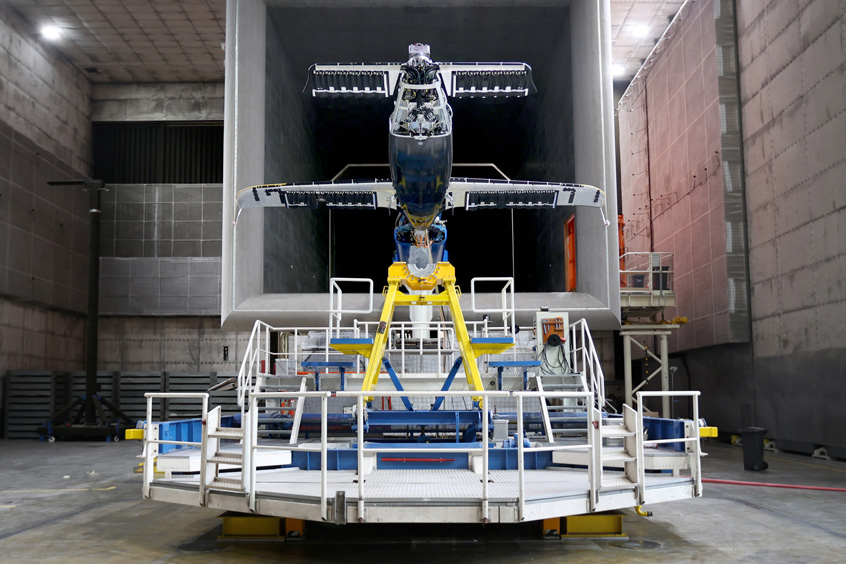
Lilium has started wind tunnel testing on a complete 1 to 2.5 scale (40 per cent size) Lilium Jet model, including working engines and flap actuators, at the German-Dutch Wind Tunnels (DNW) facility in Marknesse, Netherlands.
This latest campaign follows Lilium's previous successful wind tunnel testing of aircraft sections in 2021 and 2022 and represents a major milestone in the development of the type-conforming aircraft. Having started in early May, the testing will enable Lilium to obtain a comprehensive aerodynamic dataset to validate its flight physics and performance predictions. The dataset will cover the complete aircraft flight envelope from hover to cruise.
The scale model, one of the most advanced ever to be tested in a wind tunnel, was built according to the latest Lilium Jet design by TGR-E, a provider of high-end manufacturing solutions, supported by aerospace design specialists IBK-Innovation. The large size and low scaling factor chosen for the model allow test data to be generated that is representative of the full-scale aircraft in all phases of flight.
The scale of the model was also made possible by the dimensions of the DNW facility, which is the largest wind tunnel in Europe, measuring 9.5m (31ft) in width. Each flap is remotely actuated and equipped with electric ducted fans built to scale by aerospace propulsion engineers Schuebeler Technologies.
DNW has played an important role in the development of the aviation sector since its establishment in 1976 by the German Aerospace Center DLR and the Dutch National Aerospace Laboratory NLR. DNW's wind tunnels have been used in the development of all Airbus aircraft, from the A300 to the A380 and A400M, as well as the Embraer E-jet family and numerous helicopters.
Lilium chief technology officer Alastair McIntosh says: “This is an important step in our aircraft programme, and it is very exciting to see this large-scale Lilium Jet model with working engines and wing flaps. We've been enormously impressed by the cooperation with DNW so far and the support provided by TGR-E and IBK. We look forward to generating vast amounts of aerodynamics data on the aircraft and building further confidence in our design tools as we prepare for the start of final assembly later this year.”