


 The bimonthly news publication for aviation professionals.
 Read this story in our September 2022 printed issue.
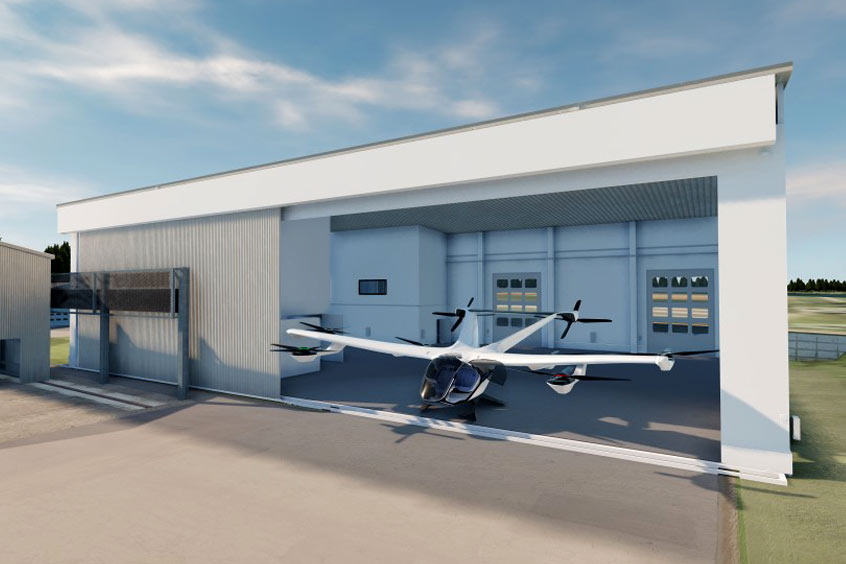
Airbus Helicopters has started construction of a test centre in Donauwörth, Germany for its CityAirbus NextGen, with company representatives, politicians and business leaders attending the ground-breaking ceremony. The building is scheduled to be completed in the first quarter of 2023. Occupying a surface area of 1,000 sqm, the new structure will be used for testing systems for electric take off and landing vehicles (eVTOLs). The ceremony was attended by the Federal Government Coordinator of German Aerospace Policy Anna Christmann.
“We are investing in the future of electric flight because we believe this technology holds key potential for zero-emission flights,” says Wolfgang Schoder, managing director of Airbus Helicopters in Germany. “Urban air mobility will change the way we travel in cities and beyond, and it will be a new pillar of business for Airbus. Donauwörth plays an important role in the development and construction of the CityAirbus NextGen.”
"With the ground-breaking ceremony for the urban air mobility test centre at the Donauwörth site, Airbus Helicopters is laying an important foundation for the further progress of electrically powered aircraft," adds Christmann. "As the federal government, we welcome the efforts made by industry to develop new propulsion systems and aircraft that will enable climate-neutral aviation in the future."
The hangar integrates high voltage equipment and lithium batteries and is designed to undergo testing with the highest safety precautions. All tests needed before the CityAirbus NextGen's maiden flight can be carried out there. These tests cover the electric motors with their eight rotors as well as the aircraft's other systems such as flight controls and avionics.
In September 2021, Airbus unveiled its eVTOL prototype, the CityAirbus NextGen, to explore advanced air mobility technologies and bring urban air mobility services to life. With a range of 80 km and a cruise speed of 120 km/h, it has been developed to be suited for a range of deployments in urban areas. As well as carrying passengers, the aircraft could also be deployed on medical missions or used in an eco-tourism context. Over the past few months, the company has selected partners for the main structural components of its prototype. Airbus is also working closely with industrial and institutional partners to lead the development of urban air mobility ecosystems, as recently announced with ITA Airways in Italy, or through the launch of the Air Mobility Initiative in Germany.