



 The bimonthly news publication for aviation professionals.
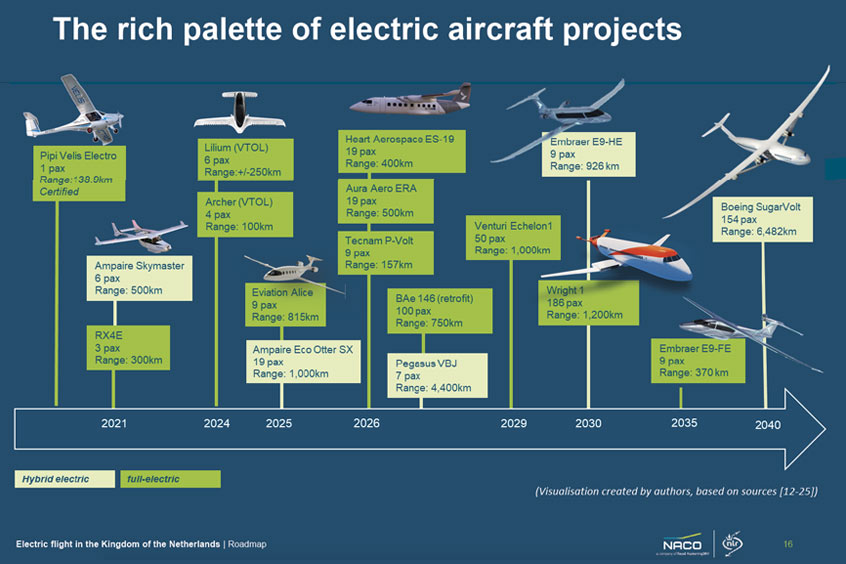
A study by NACO (Netherlands Airport Consultants, part of Royal Haskoning DHV) and Royal NLR (Netherlands Aerospace Centre) finds that it is feasible to electrify small-scale aviation in the Kingdom of the Netherlands over short distances by 2026. The study, recently presented to the House of Representatives, gives integrated attention to the aviation ecosystem of stakeholders and all technical, logistical, energy and financial aspects that play a role in the design of electric aviation. The availability of the devices and batteries, the layout and logistics at the airports, charging technology, (renewable) energy facilities and costs were all examined.
The study mentions several challenges. On the aircraft side, these include developing batteries, certifying new aircraft and scaling up production to meet demand. On the ground, these are adapting the infrastructure and legislation and regulations, setting up sustainable energy sources and answering to the peak in energy demand during charging. Despite the challenges, the researchers support the conclusion that it will be possible in the foreseeable future for electrically powered aircraft, with a capacity of up to 19 passengers on routes up to 200 km, to structurally take over the role of traditional aviation.
NACO director Esther Kromhout says: “Our study makes a valuable contribution to the discussion about the future of electric flying and its role in making aviation more sustainable. The roadmap shows what is possible in the near future (2026-2030) based on current technical developments. It is a realistic scenario that becomes feasible when the stakeholders actively seek cooperation with each other. We are only at the beginning; this is a small but important piece in the larger puzzle of the global transition to zero emissions and truly sustainable aviation. These are all topics that we deal with on a daily basis.”
“With our fully electric Pipistrel Velis Electro, we have already shown that electric flying is possible. At the moment, this only applies to small aircraft and over short distances," adds Martin Nagelsmit, head of the Sustainability and Environment department at Royal NLR. “The challenges also lie on the ground and in policy and legislation, as we now experience almost every day. In addition to electric flying, even more is needed to make aviation more sustainable. There is not one holy grail that solves the climate impact caused by the current generation of aircraft. To adequately tackle the entire spectrum, we must focus on various solutions, such as hydrogen propulsion, sustainable fuels and even more efficient aircraft and operations.”
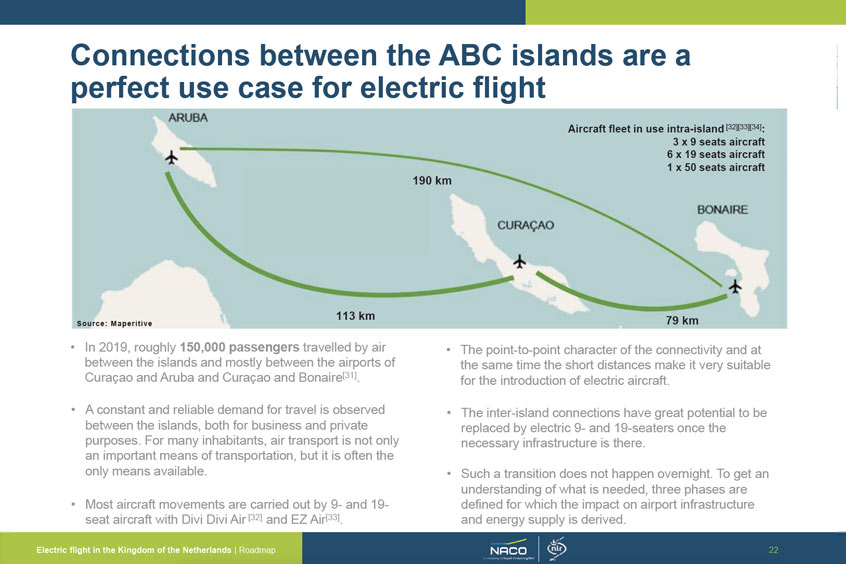
The study used the flight schedule between Aruba, Bonaire and Curaçao to make the impact of the introduction of electric flying quantifiable, in terms of infrastructure, energy demand and costs. Insights into both the investments and the operational costs of converting commercial air traffic between the three islands in three phases is given: first start small in 2026, and then reduce the air traffic (as measured in 2019) by 50 per cnet in 2030, and 100 per cent to be fully electric by 2035. With the knowledge gained from this study, the potential for application in the Netherlands and in the Kingdom, can also be mapped out.