 The bimonthly news publication for aviation professionals.
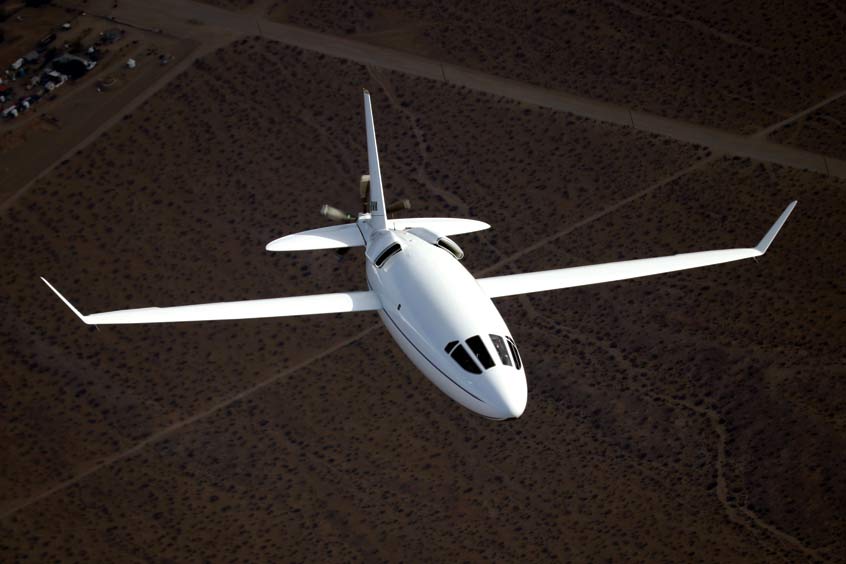
US business aircraft developer Otto Aviation has officially concluded phase one testing of its Celera 500L aircraft, with a total of 55 successful test flights and roughly 51 hours of flight time.
The final phase one test flight was flown using SAF, further validating the Celera 500L's potential to revolutionise sustainable air travel in an aircraft that already has 80 per cent lower fuel consumption than comparable aircraft. All test flights have validated the aircraft's operating performance goals.
The Otto Aviation team used industry standard flight test performance methods that helped refine the statistical certainty of the prototype performance. The most recent flights took place from July to November. Several flights reached airspeeds of over 250 mph at altitudes up to 15,000 ft, which projects to an airspeed of 460 mph at 50,000 ft.
During test flights, the team was able to visualise the laminar flow state with a precision infrared camera mounted on a chase aircraft, quantifying extensive laminar flow capability on external surfaces. The team also tested wing and fuselage surfaces for laminar flow robustness and gathered additional test data supporting the development work for the production vehicle.
Through a collaboration with Cal Poly's BLDS (Boundary Layer Data System) team, Otto Aviation was able to quantify the skin friction state of the wing and fuselage surfaces utilising a series of Preston-type, pitot-static tubes. Additionally, the company was able to collect data from custom-built boundary layer rakes to measure the cumulative effect of laminar friction on the airflow around the wing and fuselage.
“The data from our first phase of test flights shows that we are on the path to achieving our goals for the aircraft,” says CEO William Otto. “We couldn't be more excited in this step toward our mission of having a production aircraft in 2025, and we look forward to beginning the next phase of development where we will take the aircraft to higher altitudes and higher speeds.”