 The bimonthly news publication for aviation professionals.
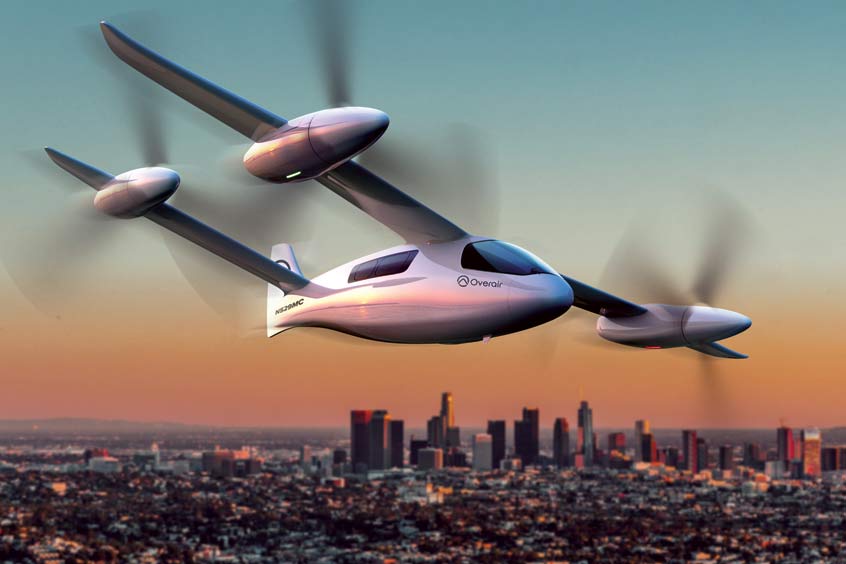
Santa Ana, California-based Overair has revealed the commercial design of its Butterfly all-electric vertical takeoff and landing (eVTOL) aircraft for advanced air mobility. Until now, Overair's team of engineers and technicians has been operating in stealth mode, integrating technologies from over 20 years of aerospace innovation led by Abe Karem, designer of aircraft such as the Predator. Leveraging that legacy of the Department of Defense and privately backed technology, Butterfly is designed to be the most robust, efficient, and quiet aircraft in its class, a mobility workhorse that produces zero carbon emissions in flight.
Butterfly's capability stems from its propulsion system, known as Optimum Speed Propulsion (OSP). The aircraft's four large propellers spin slowly in hover and even slower cruise, resulting in two primary aerodynamic advantages. First, the props are so efficient that hover flight consumes only a small fraction of the available motor power, giving Butterfly extra payload capacity and power margins to operate safely in challenging environmental conditions. Secondly, the slow-turning props produce very little noise, optimising Butterfly for high-density routes over sensitive communities.
Overair intends to commercialise Butterfly's competitive advantages to become a global leader in advanced air mobility, vertically integrating to meet demand as a manufacturer, maintainer and operator. “This is just a fundamentally different type of aircraft,” says Overair CEO Ben Tigner. “Butterfly is a transportation system optimised for safety, utilisation, passenger experience and affordability. Our goal is to become a trusted part of our riders' daily routines and a trusted partner for the communities we serve.”
Butterfly's design combines the low energy and maintenance costs of all-electric vehicles with the robust flight qualities of OSP, unlocking a reliable aviation solution over congested metropolitan areas. This combination will enable Overair to pass Butterfly's value to its customers through competitive pricing with today's ground transportation options.
Amid the rising focus on reducing aviation's carbon footprint, Overair expects to certify Butterfly with the FAA in 2025. Following certification, Overair will launch commercial operations in targeted US and South Korea markets, where the company's strategic partner Hanwha Systems is leading in AAM.