


 The bimonthly news publication for aviation professionals.
FreeFlight Systems has released a new series of radar altimeters for the heavy rotorcraft, turboprops, business aviation and military segments that is designed to mitigate 5G interference. Decades ago, when the original specification was created for the radar altimetry, the radio frequency (RF) environment was protected. However, with new terrestrial broadband datalink systems such as 5G, and as identified by the RTCA Special Committee, these devices may be compromised.
The new radar altimeters feature redesigned RF circuitry built to withstand 5G interference. This adaptation will increase the availability and reliability of this critical sensor, the only sensor on board an aircraft capable of detecting clearance height above terrain, in those challenging RF interference environments.
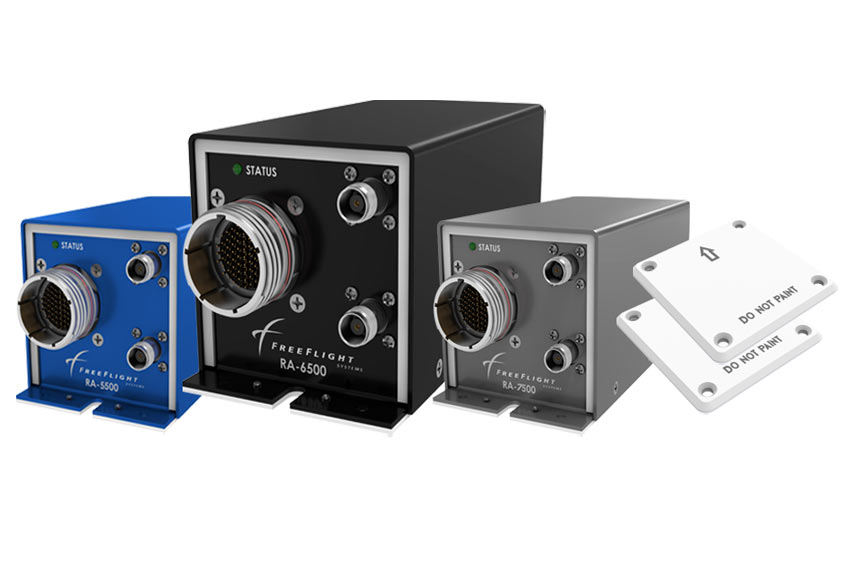
The altimeters, dubbed the Terrain series, includes the RA 5500, RA 6500 and RA 7500 radar altimeters for multiple aviation markets, beginning with the RA 6500, which is focused on Part 29 heavy rotorcraft and business jet markets. The RA 6500 also features comprehensive interface capabilities, including the ARINC 552 legacy interface, which allows integration with legacy analogue indicators, greatly simplifying the retrofit of the system. As an additional display option, the RA 6500 can be paired with the FreeFlight Systems RAD45 standalone indicator, which meets EASA AMC1 SPA.NVIS.110(b) guidelines.
The TSO'd, DAL-B rated RA 6500 meets the FAA's most rigorous design standards, including TSO-C87a Class A, ETSO-2C87, DO-160G and DO-178C, ensuring commercial transport and military-grade operability.
The RA 6500's small footprint means that it can easily be installed in place of legacy altimeters from multiple manufacturers. The existing antennas can also be used in most installations, making the RA 6500 a very straightforward retrofit solution.
“The design represents the forward-thinking, future proof technology that FreeFlight Systems is known for,” says Tim Taylor, FreeFlight Systems CEO and president. “The Terrain family is designed for robust operation in future environments and platforms while offering a simple retrofit path for replacement of older less capable altimeters in service today.”
The Terrain series altimeters feature dual-install capability making them suitable for installation in Part 29 rotorcraft and larger fixed-wing aircraft. The feature-rich radar altimeters have an update rate of 25 times per second (25 Hz), frequency-modulated continuous-wave (FMCW) at 4.3 GHz centre frequency, an altitude range of -20 to 2,500 ft, antenna response angles of up to ±20° pitch and ±30° roll, and a service ceiling of 55,000 ft. This design allows for robust operations and reliability.