

 The bimonthly news publication for aviation professionals.
 Read this story in our April 2020 printed issue.
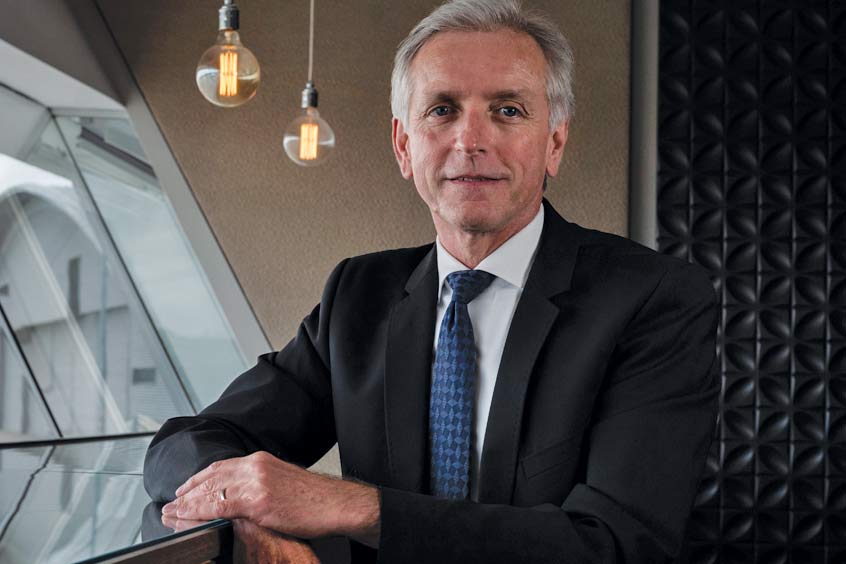
For our Perspectives series, we talk to experienced business aviation industry professionals, who share with us their unique insights and offer a window into their world. This month's interviewee is Brandon O'Reilly, CEO of Farnborough airport. There is never a dull moment at the airport, which was recently forced to cancel its world-renowned air show, and Brandon and his team have been lauded for implementing carbon neutrality:
“2019 was a record-breaking year at Farnborough for the third year in a row, with regards to air traffic movements; movements for 2019 over 2018 were 5.3 per cent up, which put us at just over 32,000 movements per year. Our planning consent allows us 50,000 movements a year, so it’s an airport with available capacity.
The Gulfstream facility that was announced 18 months or so ago is one of our major pieces of news. Construction started last year and has really taken hold. This will be Gulfstream’s major maintenance and overhaul facility outside of the United States, located here at Farnborough. The external building is now virtually complete and in the summer time it will be launched and open. It is an enormous 230,000 sq ft facility, and Gulfstream is building it with its contractors, and leasing the land from us. That really started last year and has rolled through into this year. It’s an extraordinary building – the single largest piece of infrastructure here at the airport.
The other news towards the end of last year was that the airport changed ownership and is now Farnborough Airport Ltd, owned by Macquarie Infrastructure and Real Assets, part of the Macquarie Australian bank. That took place at the end of September last year. It’s business as usual for the management team.
Looking ahead, we have a number of other points to consider for 2020, not least of which is the environment. This is clearly at the top of everyone’s agenda now; you can’t go to any conference, you can’t have a discussion with anybody, without referring to the environment, and rightly so. We’ve been taking this seriously for many, many years now. We wrote a masterplan in 2009 where we stated that we were going to become a carbon neutral airport and do all possible within our remit to reduce our effects on the environment. A couple of years ago we were credited with carbon neutrality by the Airports Council International’s programme ACA, and we’ve since had that renewed. I’m often asked about wider neutrality, for the people who use the aircraft and the aircraft too. Those aircraft need fuel to fly, and there is an alternative to Jet-A1 – sustainable alternative fuel (SAF) – and the key issue regarding that is availability, price and demand. We’ve tried to take a leading-edge stance on that by hosting an event here last May to help educate the business aviation community about SAF. We also sponsored a lunch towards the end of the year at NBAA in Las Vegas on the same subject. We would like to be one of the first, if not the first, airports in Britain to be able to supply SAF on a consistent basis at a consistent and competitive price. It’s going to take a lot for that to happen, but we want to be at the forefront – we are aggressively pursuing this.
On 27 February we implemented an airspace change around Farnborough. This was part of our environmental commitment. We were granted an increase in permitted movements here in 2011 by the local council, and we committed to improve aircraft routings on departure and on arrival, so that they overfly built up areas less frequently. To do that we needed to change our airspace from Class G to Class D (controlled airspace). This was approved and has finally come to fruition now. Aircraft will now fly on ‘railway lines in the sky’ rather than in uncontrolled airspace as previously. They will be on prescribed routes that will overfly built up areas less, and the aircraft will be able to climb more quickly into the airspace and remain higher for longer before descending, which will reduce disturbance. We are very pleased about this development.
Here at the airport, we have not seen any demonstrable effect of Brexit on our business. Brexit is change, change is opportunity, and opportunity creates travel. That’s what we’ve seen – an increase in movements during a time of intense uncertainty. It’s going to be interesting to see what happens in the next 12 months as we go through the transition period, but so far we have actually seen growth rather than a decline in the number of movements. Movements within Europe were up last year (six per cent increase), as were movements from the US to us. So we’ll wait and see.
All airports have caps on them, be it a passenger number cap or a movements cap. We don’t have a passenger cap, because we have a very small number of passengers per flight, but we do have a movements cap. That’s to protect the environment, and it’s regulated by our local council. We have grown from 25,000-odd movements to over 32,000 movements while reducing our impact on the environment, and that’s the aim going forward – to grow sustainably. It’s not easy, but we have been working on this for 10 years now and this is going to continue."