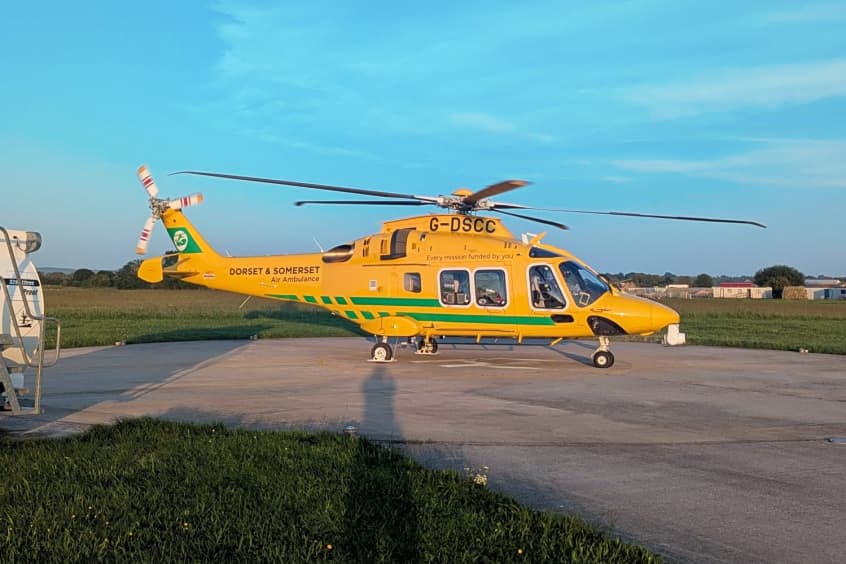
• Dorset & Somerset Air Ambulance
• Leonardo Helicopters
Aircraft
BAN's World Gazetteer
• U.K. The bimonthly news publication for aviation professionals.
 Read this story in our July 2017 printed issue.
UK charity Dorset and Somerset Air Ambulance's factory-new AgustaWestland AW169, operated by Specialist Aviation Services (SAS), has entered service. SAS is also overseeing deliveries of two other AW169s to Kent, Surrey and Sussex Air Ambulance, and Lincolnshire and Nottinghamshire Air Ambulance. DSAA's helicopter is the first of its type to perform air ambulance operations in the UK and its aeromedical fit installed by SAS includes a searchlight and night vision goggles.
CEO Bill Sivewright says: “It has always been our aim and vision to pursue clinical excellence. Pairing critical care teams with the outstanding capabilities of the AW169 is a natural development of that vision. Patient benefit remains our top priority and this was the single biggest criteria in selecting this helicopter.
“Another major plus in selecting the latest generation of aircraft is that you are taking advantage of the latest advances in technology; it is safer and easier to maintain and operate.”
The medical equipment in the AW169 will be similar to that of the charity's previous aircraft, an EC135, but the main difference will be felt in the size of the cabin. “The critical care team will be afforded complete access to a patient, from head to toe if further intervention is required en-route to hospital,” Sivewright adds.
Over the past few months, the service has increased its operating hours from 12 to 19 hours a day. During hours of darkness, crews are deployed using a critical care car.
He continues: “We are most grateful to SAS, whose team has worked closely with ours to develop this medical interior. The AW169's night flying capabilities mean that we can now move forward into providing full night HEMS. Our team will be able to fly directly to the patient without the need of any fixed or pre-established lighting, which is a significant advantage. The aircraft had to undergo close scrutiny from EASA, which took longer than we anticipated. But it has certainly been worth the wait.
“I am proud to say that we can meet any challenges head on because of the people of Dorset and Somerset. This has only been possible through their support.”