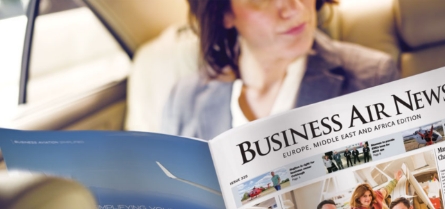
 The bimonthly news publication for aviation professionals.
At present we are experiencing a tough time in the industry with most companies feeling the effects of a downturn. However I am not convinced that the downturn is quite as severe as it might seem at first sight.
New aircraft sales are down but they had been artificially high due to the effect of the fractionals. If we compare sales from pre-fractional days, I think the picture will not look so gloomy. There has been a downturn but we must be careful not to talk ourselves into further problems.
At times when we are experiencing such downturns and all companies are looking at bottom lines, corporate travel comes into its own. The corporate aircraft is a very efficient management tool. All of us can cite cases where the company has made great savings in employees’ time, costs of hotels, and wear and tear on the individual’s travelling.
And that is to say nothing of giving passengers the feeling of security and well-being that comes with personalised travel arrangements. This is the message to get across to the doubters. Pose not the question: ‘Can we afford to run a corporate aircraft?’ but ‘Can we afford not to?’ We are slowly convincing the authorities, the press, the rest of the aviation industry and the public at large that the service we provide, in the majority of cases, benefits our own business, local communities and ultimately the nation as a whole.
However there are still the uninformed who every now and then take a pot shot at what is seen by some as the ‘Admiral’s Barge’. It is the responsibility of all of us to make sure that perception is shed for ever. By acting as good neighbours in areas of noise, security and emissions we can convince local authorities that local airports are good for their business too.
This will pay dividends by not giving the doubters excuses for complaining. Co-operating and communicating with the larger and busier airports on slot-keeping is a single example of how we can all enhance our reputation at those airports.
Today we are operating some of the most sophisticated equipment available, supplied by manufacturers who are second to none and backed up by service suppliers and a support industry that has never been better. We are also well respected by the legislators and they are asking our advice and guidance as never before – the recent JAA/EASA changes being a prime example where our work has saved the industry from unnecessary over-legislation.
We have many reasons to be confident and proud of our industry so let’s go out and tell everybody about it. That is what we at the BAUA are going to do and, together with our colleagues in other associations both in the UK, Europe and internationally, we can all benefit when the economy lifts.
The work that the associations do – BAUA, GAMTA, BHAB and EBAA, along with others – is vital to us all if we are to maintain access to airfields and airspace at a cost which is not prohibitive. We must work closely together as associations to make certain we do not duplicate effort so we are seen by the authorities and by our members to be working as one, for the benefit of the whole of our sector of the industry.
I am confident that all of us working together can make sure that we represent and protect the interests of our section of the industry to the betterment of us all.
John Batty BAUA chief executive