See more information from the Business Air News Handbook
Press Release
Issued by Blackhawk Aerospace Upgrades.
July 22, 2024
Blackhawk Aerospace, the leading provider of aftermarket engine upgrades for turboprop aircraft, has proudly announced the release of the highly anticipated PT6A-66D supplemental type certificate (STC) programme for the Daher TBM 700 series aircraft. The STC effort will encompass the TBM 700A, 700B and 700C2 models and will elevate their performance to that of the TBM 850 model. Blackhawk is partnering with AVEX Aviation, an elite TBM sales and performance centre, to develop an upgrade that offers significant enhancements in horsepower and overall performance, setting a new benchmark for the TBM series.
The engine upgrade programme, dubbed as Blackhawk's XP66D Engine+ Upgrade, installs a factory new Pratt & Whitney PT6A-66D engine to replace the incumbent PT6A-64 engine. With a mechanical horsepower increase from 700 HP to 850 HP, the TBM 700 series will experience a remarkable boost in both climb and cruise performance. Specifically, the time to climb from sea level to 31,000 feet is reduced from 16 minutes and 39 seconds to just 14 minutes, while maximum cruise speeds at various altitudes will now range from an impressive 287 ktas to 307 ktas.
"The new XP66D engine upgrade exemplifies The Blackhawk Group's commitment to pushing the boundaries of innovation in the aviation industry," stated Edwin Black, president of Blackhawk Aerospace. "By partnering with our sister company, AVEX, we are able to combine its vast expertise in all things TBM with Blackhawk's extensive knowledge of STC development to offer an unparalleled upgrade for our mutual customers."
Key benefits of the XP66D Engine+ Upgrade include;
- Improved climb rate: Faster time to reach optimal cruising altitudes, enhancing operational efficiency.
- Higher cruise speeds: Introducing 850 mode will generate higher true airspeeds at various altitudes, improving overall flight performance.
- Lower operating costs: Significant reductions in annual operating costs, adding value to the investment.
- Enhanced safety margins: Increased power translates to better safety margins across the entire flight envelope.
- Operational flexibility: Greater horsepower provides more options for varied missions and conditions.
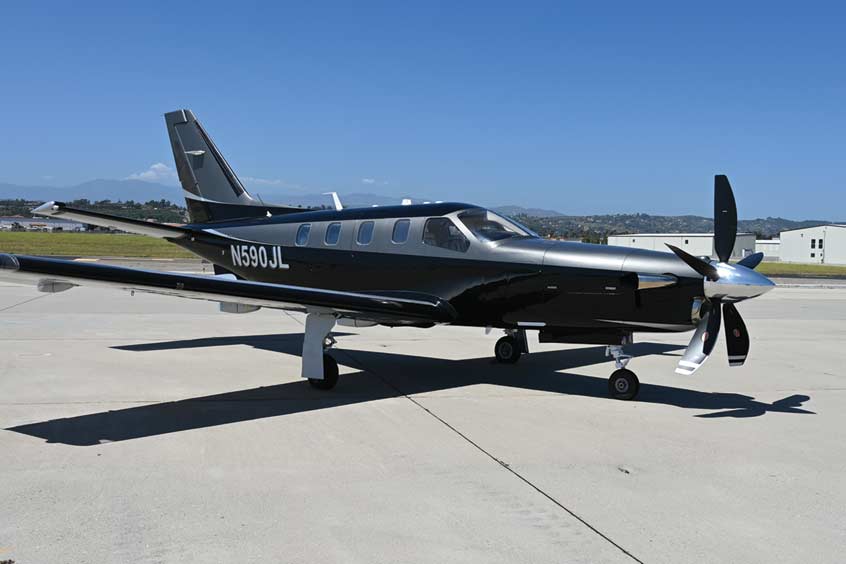
The testbed aircraft for Blackhawk's certification programme is a 2004 TBM 700C2 (N590JL) and is on display this week at EAA AirVenture in booth #322. This aircraft features a full Garmin panel, a brand-new interior and a new LED interior lighting system, all of which were installed by AVEX at its Camarillo Airport (KCMA) location in California.
The aircraft's updated Garmin panel includes:
- Dual G600TXis with engine indication on 10-inch GDU displays and a GCU 485 GDU controller
- GFC 600 digital autopilot with envelope protection and auto rudder trim
- GI-275 electric standby indicator
- GTX 345R remote mount ADS-B In & Out transponder
- GTX 335R remote mount ADS-B transponder
- GWX 75R digital colour radar, upgrade compatible to a GWX 8000.
The work done at CMA, overseen by AVEX avionics manager Erik Miller, includes design, wiring, fabrication and installation, and features enhanced redundancy, user-centric design and envelope protection to meet the highest standards of safety and reliability. N590JL also features a fresh custom paint scheme designed by AVEX and applied by ArtCraft Paint at Capt G. Allan Hancock Field (KSMX) in Santa Maria, California.
With the introduction of the XP66D Engine+ Upgrade, Blackhawk and AVEX continue to lead the way in aviation innovation with a proven track record that spans over 30 STCs and nine turboprop airframes. The -66D conversion not only transforms the TBM 700 series but also redefines expectations for turboprop performance.