See more information from the Business Air News Handbook
Press Release
Issued by Russian Helicopters, JSC.
August 24, 2020
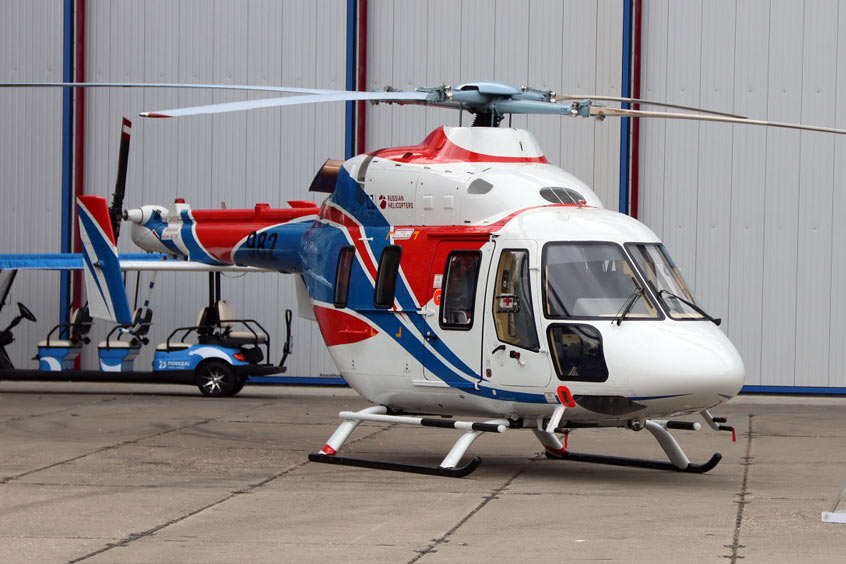
Russian Helicopters' Kazan Helicopter Plant has received approval from the Federal Air Transport Agency for changes to the Ansat helicopter's standard design, confirming the possibility of using a new medical module with improved access. In addition, the Russian aviation authority has approved changes to the standard design of the Ansat, enabling the helicopter to be equipped with removable controls for the co-pilot. Both options improve the use of the Ansat helicopter as an ambulance.
The new medical module, manufactured by the Kazan Aggregate Plant, has a modified layout that facilitates loading and unloading a patient. Now this process has become more convenient thanks to the use of standardised stretchers, equipment and gurneys. All manipulations for loading and unloading the patient can now be performed by one medical worker. The patient can be moved from the helicopter to the ambulance without additional transfer, and even a short-term shutdown of life-support devices does not occur, which significantly reduces the risks for the patient during transportation.
In addition to the specialists of the Kazan Helicopter Plant, experts from Centrospas EMERCOM of Russia, TsEMP (GBUZ Scientific and Practical Center for Emergency Medical Aid of the Moscow Department of Health) and VTsERM (All-Russian Center for Emergency and Radiation Medicine named after A.M. Nikiforov EMERCOM of Russia), as well as and operators of the Ansat helicopter, took part in the development of the module layout.
"A medical module with the increased convenience of loading a patient will be installed in Ansat helicopters as an option. Additional guides will appear on the ceiling in the helicopter cabin to which medical equipment and lighting systems can be attached and moved in the most optimal way in relation to the position of the patient during the evacuation process. The previous version of the medical module will also continue to be available to customers. Both modules have their own advantages, depending on the tasks set," said managing director of the Kazan Helicopter Plant Yuri Pustovgarov.
The Federal Air Transport Agency has also certified the use of removable controls for the co-pilot on the Ansat helicopter. This configuration allows both technical and flight personnel to dismantle quick-release levers and pedals from the co-pilot's seat in a few minutes without using a tool and remove them to specially equipped attachment points. As the Ansat can be operated by one pilot, it is now possible, thanks to this innovation, to accommodate an additional passenger in the cockpit if necessary. This option is especially relevant in medical aviation, when an accompanying person or another paramedic needs to be taken on board the helicopter with the patient.
The Ansat is a light twin-engine multipurpose helicopter, the serial production of which is performed by the Kazan Helicopter Plant. According to its type certificate, the design of the helicopter allows it to be quickly transformed into both cargo and passenger versions with the ability to carry up to seven people. In May 2015, an addendum to the type certificate for the modification of the helicopter with a medical module was received.
The Ansat is certified for use in the temperature range from -45 to +50 degrees Celsius, as well as for operation in high mountains. In August 2018, based on the results of certification work, Rosaviatsia issued Kazan Helicopter Plant approval to increase the resources of a number of Ansat units and systems. In 2019, the Federal Air Transport Agency certified an increase in the fuselage resource of the Ansat light helicopter to 16,000 hp. In February 2020, the Russian aviation authorities certified the installation of an emergency splashdown system on the Ansat. Also, approval was issued for a major change to increase the airworthiness limitations of a number of main helicopter units, which makes the Ansat helicopter even more attractive to potential customers and increases its competitiveness in comparison with foreign helicopter technology.