


See more information from the Business Air News Handbook
Press Release
Issued by ADAC Luftrettung.
August 23, 2024
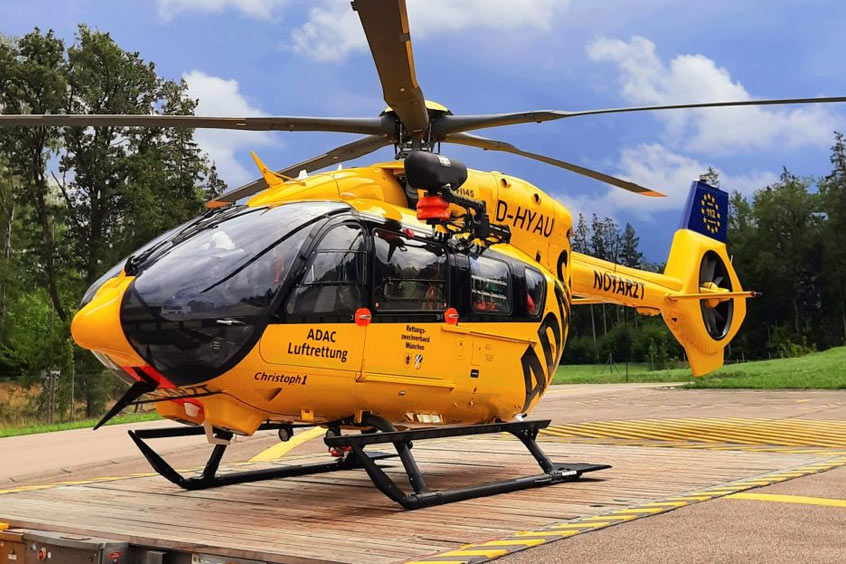
German non-profit aeromedical operator ADAC Luftrettung is continuing to modernise its fleet. The newest and most modern Airbus H145 rescue helicopter with a five-blade rotor and winch is now in use at the air rescue station at Munich's Harlaching Clinic. The company is thus investing in even better quality of care and flight safety for its patients and crews.
The new ADAC rescue helicopter offers more power and can fly with up to 100 kilogrammes more payload than its predecessor. Because more kerosene can be carried, helicopter's maximum flight time has also increased by around half an hour. "This is a huge improvement and range increase, which is particularly advantageous for the urgent transport of seriously ill patients between hospitals," says station manager Roland Benning, highlighting the special features of Airbus Helicopters' most modern rescue helicopter. "The fifth rotor blade makes the H145 even quieter in the air, which means less vibration in the interior and therefore a gentler transport for the patient."
With two engines of around 900 hp each, the helicopter is powerful, allowing the flying Yellow Angels to reach accident victims and hospitals as quickly as possible at a top speed of up to 260 kilometres per hour. The maximum take-off weight is 3.8 tons. The weight of the new H145 is lower than that of the previous model, meaning it has more payload capacity, which can be used for additional special equipment or medical personnel to care for intensive care patients.
Last year, ADAC's Munich crew was called out to 1,621 missions around the state capital, including 97 with rescue winches. The new H145 is also predestined for such highly demanding special missions in the mountains or hard-to-reach locations due to its high performance. Munich is the fourth ADAC station where the five-blade technology is being used.
ADAC Luftrettung offers different types of helicopters depending on requirements. For primary missions such as emergency missions, the company still mainly relies on the H135 helicopter, the rescue helicopter most frequently used in German air rescue. Compared to the H145, it is smaller and more manoeuvrable, with correspondingly less downwash, and therefore has advantages in urban, densely built-up areas. It is also cheaper to purchase and operate.