

Press Release
Issued by FlyOnE.
March 11, 2022
FlyOnE, an Australian pioneer of goods and services in the emerging green transport market and a leading supplier of electric aircraft, today announced a new partnership with Israeli creator of eVTOLs for the consumer market, AIR. This partnership will facilitate the delivery of 25 AIR One aircraft, Australia's first two-seater eVTOLs for private recreational use.
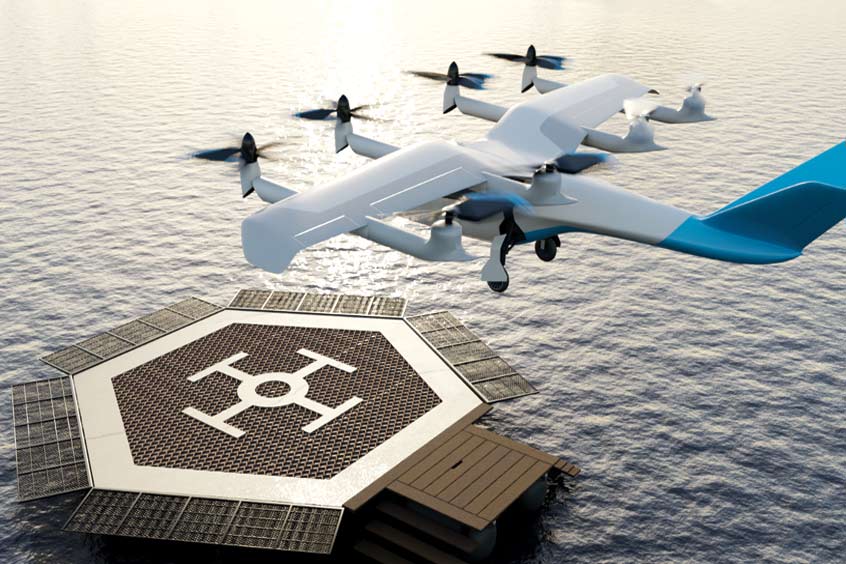
In addition, FlyOnE is announcing the rollout of mobile water landing pads with aircraft recharge capabilities as well as partnerships with key airfields to operate recharge nodes for existing electric fixed-wing aircraft on the Lilypad Elevate electric aviation network with operations beginning in March 2022.
“FlyOnE is excited to be working with AIR to bring the world's first metropolitan eVTOL network to Perth as early as 2025,” said Korum Ellis, founder at FlyOnE. “With our unique Lilypad landing and charging system, the AIR One personal two seater electric VTOL can access a variety of waterfront destination sites and airport locations up to 100klm away. In addition, existing fixed-wing electric aircraft available now can access select runway sites on this same network from March 2022."
“We are thrilled to help introduce Australia to the future of electric aerospace mobility and to begin to build true consumer confidence in AIR One as a natural mode of everyday transport,” said Rani Plaut, CEO and co-founder of AIR. “With the help of market trailblazers like FlyOnE, we believe Australia will be one of the global early adopters to help scale personal air mobility around the world.”
The benefits of this new partnership include:
- Some of the world's earliest delivery of recreational electric VTOL aircraft being allocated to FlyOnE clients in Australia
- Enabling the world's first International standard AS6968 eVTOL network of charge nodes and metro eVTOL self-piloted air travel to be established and operated in Perth, Western Australia.
- Construction of the network and operation and training around the aircraft piloting and maintenance will generate Jobs in western Australia, stimulate employment and drive unique tourism opportunities
- Connecting new and existing tourism destination sites with point to point self-piloted electric air travel enables these sites to offer a client experience second to none anywhere else in the world.
Bindoon Formula 1 racetrack resort partnership:
FlyOnE and Club Moolia have begun plans to establish a landing site at the Club Moolia private racetrack resort location north of Perth, Western Australia.
Club Moolia identified a key destination in Western Australia to create the ultimate automotive, sports and entertainment experience. To aid VIP access to the site in Bindoon with a unique experiential transport method, Club Moolia is planning to maintain a charge node and landing site for the range of FlyOnE electric recreational aircraft to fly direct from private sites in and around Perth as well as FlyOnE Lilypad Elevate recharge landing sites.
“Club Moolia is excited about the opportunity to offer our clients the highest level of recreation travel experience to and from our destination with aircraft and charge infrastructure provided by FlyOnE Aviation,” says Ronald Shaw, co-founder of Club Moolia. “Whether it's arriving in a cutting edge eVTOL privately flown aircraft, racing million-dollar sports cars or simply lounging by a crystal turquoise lagoon, Club Moolia has it all.”
Cloud Dancer Aviation charge node and pilot training partnership:
FlyOnE and Perth flight school Cloud Dancer Aviation have established a charge node location that is currently operating on the northern apron of Jandakot Airport in Western Australia. This charge node currently services the states's fixed-wing electric aircraft operators at that location. Cloud Dancer Aviation is also structuring a training curriculum to train new and existing pilots in the operation of the new niche Air EV aircraft, which has unique short (vertical) take-off capabilities.
Rottnest Island Airport potential partnership:
FlyOnE and Rottnest Island Airport have also begun negotiations to establish an electric aircraft charge node at Rottnest island in Western Australia. Rottnest Island is a beautiful and unique destination opportunity for the zero-emissions aviation future. In line with its broader eco-friendly ethos, FlyOnE has proposed a grid-independent recharge node that will self recharge with renewable energy and operate completely independent of the Rottnest island electrical grid. This charge node will assist in training operations being conducted at Jandakot, as well as offer recreational electric aviators a destination location.
“Rottnest Island is committed to increasing renewable energy penetration and minimising environmental impacts including greenhouse gas emissions. Renewable energy technologies are ever-improving, allowing us to obtain energy from natural resources that can be constantly replenished,” stated Rottnest Island Authority.
Murray Field Airport partnership:
FlyOnE and Murray Field Airport, near Mandurah, south of Perth, have also reached an agreement to establish an electric aircraft charge node at the airfield to become the second-ever electric aircraft friendly airport in Western Australia and thus help create Australia's first electric aviation charge network. This charge node will assist in training operations being conducted at Jandakot, as well offer recreational electric aviators a destination location from private airfields or within easy reach of the second charge node at Jandakot airport.
“Electric aircraft will play a big part in our future training operations at Jandakot and Murray Field airports. We're excited to support FlyOnE and early electric aviation adopters with Australia's first electric aviation charge network,” said David Currey chief executive officer, Royal Aero Club of WA.
Lilypad Elevate floating charge node:
To overcome the red tape and difficulties involved in establishing vertiport operations from a land-based site, FlyOnE has developed a floating pontoon design charge node. It is a vertiport landing pad capable of receiving all eVTOL aircraft currently in development. It has onboard stored power capable of charging the AIR One multiple times and can anchor and manoeuvre autonomously or by manual control. This allows it to receive a landing eVTOL the required minimum distance of 500m from a building, and then under its own electric power manoeuvre into a dock, jetty or alongside a water vessel to allow passengers to disembark, all the while, recharging the aircraft. It can then be recharged while docked from available grid energy.

