See more information from the Business Air News Handbook
Press Release
Issued by Universal Avionics, an Elbit Systems company.
March 5, 2019
Universal Avionics (UA), an Elbit Systems Company, is continuing its research partnership with the Federal Aviation Administration (FAA) to further develop and mature new regulations to support the use of Enhanced Flight Vision Systems/Enhanced Helicopter Vision Systems (EFVS/EHVS) for rotorcraft. The FAA is evaluating the use of Heli-ClearVision as a representative EHVS to improve helicopter safety and provide operational benefit during day, night, and low visibility conditions.
Heli-ClearVision includes a SkyLens Head-Wearable Display or SkyVis Helmet-Mounted Display capable of displaying Primary Flight Display flight symbology, conformal information, Synthetic Vision System (SVS), Enhanced Vision System (EVS) with an EVS-4000 multispectral camera, and Combined Vision System (CVS).
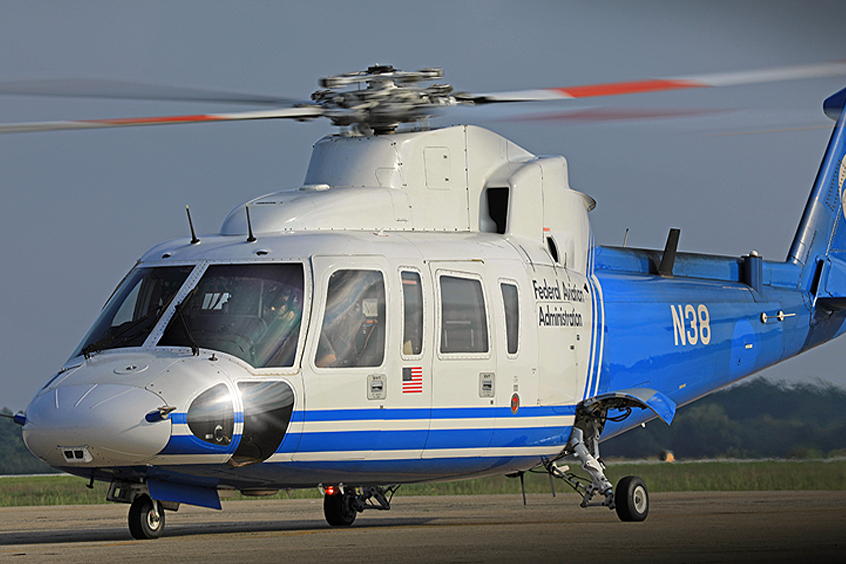
Testing hardware was fully integrated into the FAA's Sikorsky S-76 helicopter at the FAA William J. Hughes Technical Center at Atlantic City International Airport. Once integration was completed, training and familiarisation flights were conducted with FAA test pilots, followed quickly by the commencement of the FAA's planned R&D data collection flight tests. The next phase of testing is planned for early 2019 and includes additional day, night, and twilight flights with the SkyLens HWD and SkyVis HMD. Later this year, experimental trials are also scheduled and will include the SkyVis Night Vision Goggle (NVG) HMD.
"I have flown with an HMD for the majority of my flight career," said Tal Golan, Universal Avionics rotorcraft business development manager. "During that time, I personally experienced many occasions where such a system kept me out of trouble at either dark night, poor visibility or just harsh flight conditions all around.
"I know firsthand that a system such as Heli-ClearVision will not only be an overall safety multiplier, but will also greatly assist any helicopter flying at night, IMC, and any other challenging conditions to safely complete their mission. Even more so, to those who fly special missions such as SAR, EMS, law enforcement and firefighting. The programme we have with the FAA shows our dedication in shaping safer, better and more efficient helicopter operations."
This effort contributes to the United States Helicopter Safety Team's helicopter safety enhancement H-SE #91: EHVS and their commitment to reducing the helicopter fatal accident rate by exploring technologies that could enhance a pilot's ability and situational awareness to "see" the natural environment and avoid obstacles, which leads to a decrease in accidents due to Unintended Instrument Meteorological Conditions (UIMC) or Loss of Control (LOC).
"This research allows us to jointly investigate EHVS technology through both Head-Worn and Helmet-Mounted Displays coupled with CVS sensors," said Cliff Johnson, FAA research programme manager for helicopter safety. "The research directly supports the FAA's ongoing aviation safety initiatives to develop criteria for helicopter operations in low visibility environments."
The flight test programme will help quantify the unique sensor and display characteristics, visual cues, and operational concepts needed to assist the FAA with policy and rulemaking efforts to allow for the use of EHVS technologies on helicopters operating to and from helipads, heliports and landing zones.